Friday, September 24, 2010

Trees blaze red or orange and light up the landscape. Asters grace golden fields with dashes of royal purple. Woodland asters are mostly white, but leaves and goldenrods cast an autumnal glow.


Leaves come down in shimmering displays, or drop noisily when the air is calm. This morning I took the dogs for their wood walk among dancing branches. When we reached the dry creek bed it was a mosaic of yellow and orange leaves instead of bare stones.


Yesterday I was out in the woods wearing the baby in a carrier. I looked up and discovered little yellow streamers adorning a shrub no taller than myself. A witch hazel was blooming, if such a grandiose term could be used for such pale, haphazard flowers. I’ve wanted to see this for two years and now I realized why I’d overlooked them. The leaves they shared branches with were more striking. I had pictured something similar to spring-flowering shrubs, like serviceberry which blooms white against a leafless forest.


The more I looked around, though, the more witch hazel I noticed. The flowers became little treasures which rewarded my closer looks. An understated pleasure in a flamboyant season.

Monday, September 20, 2010

Leaves aren’t the only things turning. Male goldfinches look tattered with pale green showing through the gold. Warblers dart among winter residents in cryptic fall plumage, no longer singing boastful songs.

This is a time of metamorphosis. Alchemy weaves through the fabric of life. Forms change and colors shift. But modern technological societies regulate this alchemy. Birth and death, the most personal changes of all, are supposed to occur in hospitals out of sight. Smaller transformations take place in factories, laboratories, and giant farms. Much of the time people manipulate virtual objects, or at least human generated ones, rather than create from scratch.

So I try to dabble with natural forces. I cook and bake with whole ingredients. Soon we’ll fire up the woodstove, our only method of heating the house aside from leaving the oven open after the bread comes out. If there is a more human activity than taming fire, we have yet to find the archaeological evidence for it. Even using matches, we need to coax the flames as they grow and shrink along their path from newspapers to sticks to hunks of (hopefully) dry and cracked wood. I love our cast iron poker, which is simply yet ingeniously designed with a pointy end and hook that facilitate pulling and prodding logs into place.

The most important thing about working with natural forces is that the result is collaboration. We adapt our expectations and keep our mind nimble. The garden this time of year is a good illustration. Some plants never sprouted, or like the beans were grazed by slugs and rabbits until they grew stunted. Cabbage planted too late in the spring is making heads in the fall weather behind a backdrop of goldenrods.

Friday, September 17, 2010

Where are they now?


Above and to the left of the leaf bud are the pieces of the brown fruit heads of a skunk cabbage.


Hepatica leaves.


Wild leek seed head.


Berries of a false solomon's seal ripening. Unlike the skunk cabbage fruit, these are calling attention to themselves to attract seed dispersers.

Sunday, September 12, 2010

I’ve been going in the woods while wearing the baby in a sling. Sometimes she sleeps, but other times she soaks it all in. Leaves are especially fascinating. Her motor skills are continuously developing so that soon we’ll have to stop her from stuffing the closer ones into her mouth. Most forest leaves are probably just inedible. Some pack nasty surprises specifically designed for mammal browsers.

Like the single baneberry I came across on a random woods walk. It was a surreal addition to a familiar background with its fruit shaped like eyeballs on red stalks. The name comes from the fact that it’s a bane to those who sample its berries, thanks to some cardiac glucosides found in all parts of the plant. Birds and some mice, however, are immune. This is the sort of discovery I want to share with our daughter. The way the forest can be experienced in different scales and layers. I like to observe intersections of multiple histories, including both “natural” and “human.”

I love old, evocative names for plants which were obviously applied by those who paid more attention to such things than most people nowadays. These names can be based on incorrect assumptions. Take the spring flower hepatica, whose liver-shaped leaves are scattered in clumps throughout the forest where they will be green all winter before being discarded. Despite the origin of the name, this plant is not at all effective at curing liver disorders (hepat- = liver). The boneset scattered along the driveway with its strong, fused leaves adds possible liver toxicity to its lack of demonstrated effectiveness against “bone-break fever.”

A related plant, white snakeroot, is definitely toxic. I can’t find studies of its use against snakebites, but it’s infamous for spreading deadly “milk sickness” among early European settlers. Cows grazed in woodland when pasture was unproductive or unavailable would eat snakeroot and their milk would become contaminated with a toxin if they lived. Cows always seem to be eating something toxic in the annals of poisonous plants. The story of milk sickness felt much less distant when I came across this bit of the past growing on our land. White snakeroot seems particularly lush where the stream crosses the ghost of a boundary road.


But not all the stories I want to show our daughter involve humans. Nor are all the interactions in the forest antagonistic. Species can compete with, cooperate with, exploit, avoid, or even ignore each other. Interactions spread out and converge. This snag has fed fungi and insects. Woodpeckers have pockmarked the surface to find the insects, creating holes which spiders use as they weave webs to catch more insects. Poison ivy climbs up to replace the leaves which once belonged to the live tree. Poison ivy flowers cooperate to be pollinated by insects and the seeds are spread by hungry birds.

Sometimes these stories are easy to read, other times they play out over long time periods, or below the soil surface. Cooperation may not be readily apparent, like the trans-kingdom, more or less equal partnerships of fungi and algae or cyanobacteria which make up the lichens tinging many tree trunks or rocks green in our forest. In the soil, mycorrhizal fungi partner with plant roots, increasing their access to nutrients and water in exchange for carbohydrates manufactured by the plants. Little, ghostly Indian pipes actually parasitize these fungi, not the plant roots, to make up for their lack of chlorophyll.


But that’s not the first thing I think of when I stumble across a random cluster of Indian pipes in the forest. There’s the joy of discovery and recognition. I feel a connection, however brief. I want to share with my daughter a love of life and delight in all its variety. Whatever I share, she’ll find her own way.

Monday, September 6, 2010

Two days ago I borrowed a truck to haul two cords of wood home. Burning wood can be hard for me – I get so much from living trees and the act of burning anything puts various particles into the air. Fortunately our local supplier mostly cuts trees that are already slated for removal. The wood isn’t moved very far, so theoretically we’re not helping disease causing organisms spread far and wide. Some pieces were gutted with tunnels from before the wood was cut. I tried to avoid the various beetles, pill bugs, and spiders, but one spider hitchhiked on my shirt until my partner noticed the quarter-sized spread of legs and freaked out. I’m sorry to say that it was killed in the confusion.

We’re all preparing for winter. The yard was littered with brown leaves as the trees begin to shed their photosynthetic apparatus. Clouds and brisk air added to the autumnal feel. Summer and fall have been playing tug of war with the weather. Last week I stepped out of work into a steamy, oppressive haze. The landscape blushed orange, yellow and pink. Many trees had sparse canopies of brittle leaves, and goldenrod leaves had collapsed in on the stems to conserve water.

I walked into the dappled shade of the forest, where the air was warm but comfortable. The last bout of cool weather also brought our precipitation back to normal. In the rain soaked aftermath, the mulch paths smelled of damp earth and mushrooms. Now mushroom patches erupted along sections of the trail. Individuals crowded against each other, turning round caps into many-sided polygons. Patch color ranged from white to smoke-tinged. Some were sacks of brown spores which puff into the air when disturbed.

I walked across the boardwalk that passes over wetlands. Frogs announced their presence with shrieks as they flung themselves into the dredges of water clinging to depressions. The thick prehistoric undergrowth of ferns was tinged yellow, and some edges were burned brown. Before returning to work I passed through a younger section of forest with a more open canopy. The temperature rose noticeably. Sensitive ferns lay withered along the trail, not even waiting for the frost which their name refers to. Much of summer’s glory is conquered by her own excesses long before winter closes in.

Saturday, August 28, 2010

Summer's empire falling down


Joe-pye weeds losing their wispy appearance.


Cattails bursting into fluff.


Goldenrods preparing to open.

Saturday, August 21, 2010

Autumn encounters

Recently I walked into the forest during a pause in the insect buzz. Wind rustled among branches, a thin layer of leaves crunched underfoot, and, like in every other woods I’ve been in lately, a pewee was singing. I moved through one area where the brown structures of blue cohosh lay about in various states of collapse, sometimes topped with brilliant blue berries. Some poison ivy leaves were beginning to turn yellow.

I came upon a juvenile great horned owl screeching amid a chorus of chickadee chips. Perhaps because they’re used to the safety of a flock, chickadees are the self-appointed harassers of raptors. The irritated owl puffed up and shook before flapping to another perch, which excited the chickadees to chip faster and call “chickadee-dee-dee” in alarm. From the new branch, the owl turned its head backwards, seeming to contemplate whether I was also following it, and then scanned the other direction before flying out of sight. An oriole rattled from a different tree, where two of them graced the canopy with a splash of tropical color. As they flew off one sang the song that had been a familiar refrain in the yard earlier in the summer.


Mushrooms are surprisingly scarce, perhaps due to our water deficit. A few hide in the shadow of logs, or in other out of the way places. More striking are all the funnel webs propped against trees and leading down into crevices. Their makers were present earlier in the season, although the spiders’ creations were less noticeable then. In contrast, a new generation of carpenter bees is emerging, sort of a second installment for the year. Our dog Ivy scratched at the base of an old stump which may have had a tunnel, because when she left a couple of carpenter bees trundled out to investigate the damage while a third flew a low perimeter.


The one thing disturbing my peace was wariness towards a different stinging insect. I came across several solitary yellow jackets moving low to the ground, which made me anxiously glance around for more that might indicate a ground nest. When I used to work in field biology, this was the time of year we would manage to disturb a few nests. No one would notice until several yellow jackets were in place to attack with coordinated stinging. Like the hornets, the various species called yellow jackets grow their colonies from a single founder to hundreds of individuals over the course of the warm season. In a few months most will be dead, survived only by the new queens. It’s a sacrifice to the harshness of a northern winter, like the loss of the leaves in the canopy, or the above ground matter of perennial flowers.

Friday, August 13, 2010


Bald-faced hornet nest

Other animals don’t see the world as we do. I don’t know when a hornet queen decided that this old satellite dish, trash to us, was a suitable nest site. Probably soon after emerging from her winter slumber, although it was a while before we noticed that the dish was gaining grey matter. By then it was a bustling colony. Black hornets with pale yellow markings passed in and out the entrance hole. Their bodies decorated the structure as they added paper to the advancing edges of the outermost layers. It was a little intimidating to walk underneath the basketball-sized nest on our way to my mother-in-law’s house, but they were far enough from the house to consider them part of the natural world which I leave alone.

Then one night a massive insect buzzed among the usual assortment of moths attracted to the porch light. I later found out that the hornets sometimes forage by the light of the full moon. We started to keep the porch light off, not a bad idea for reducing light pollution anyways, but the last straw was when one of them followed my partner inside. She and the baby waited in the dark while I trapped the hornet under a glass. We agreed the nest should go.

Luckily a local grad student was looking for bald-faced hornets to observe. He agreed to remove our nest. The day arrived and he and his assistant came dressed in beekeeping gear and bearing butterfly nets. They set up the ladder. The once peaceful hornets came in an angry, swirling cloud while Ivy barked through the window at the humans on her territory without an escort. The researcher swung his net back and forth among the cloud until the tail was filled with a mass of caught hornets. These went in jars, which went in a cooler. Eventually enough of the defenders were captured that the researcher was able to cut away and bag the nest.


The satellite dish, which had once satisfied a certain hornet aesthetic for a building site, was now a scene of devastation. A handful of stragglers inspected the scraps of paper still clinging to the dish, having lost their purpose in life. Right or wrong, our way of looking at the world usually prevails nowadays.

Saturday, August 7, 2010


The growing season, like the dormant season, persists so long that I begin to take it for granted. Then early goldenrods begin to bloom, heralding the approach of fall. I worry that I haven’t enjoyed summer to its fullest. As I walk through green woods filled with insect and amphibian sounds, an eastern wood pewee sings a lonely song. The forest isn’t empty, but many other birds have abandoned breeding behavior and even breeding territories.

I know I’m just objecting to the way time marches forward and every other being insists on living its life while I’m preoccupied by mine. Summer is still here. We have plenty of domesticated pleasures to indulge in like zucchinis, tomatoes, and blueberries ripe for picking. Cardinal flowers beckon just beyond where woods meet lawn. Dragonflies hover over remnants of the stream, disturbing the water with their wingbeats. Lush stands of poison ivy whisper “mindfulness” against my boots.


Maidenhair ferns


Cardinal flower


Skunk cabbage disintegrating

Monday, August 2, 2010

Even in his summer coat, Bear is a furry dog. Plant parts regularly stick to him, such as raspberry canes that drag along on the ground, or sticky leaves that mat his fur. Lately whenever we walk in the woods, Bear becomes festooned with little green burrs. His hitchhikers come from robust burdocks, unassuming enchanter’s nightshade, and several other plants currently unknown to me. The stalks with their dried burrs lie in wait all through the year for their more mobile neighbors to brush by.


Enchanter's nightshade

Not that plants are as motionless as they appear. Their movements may even occur over the course of a day. Many of our early spring flowers open in bright light, thwarting my attempts to photograph them. Other movements, though slower because they are a result of plant growth, actually move the plant along the ground. Wild strawberries and poison ivy send runners into the driveway, anchoring into the ground and growing leaves until we drive the ends into the mud.

Other than champion growers like kudzu, most plants need help to actually colonize new areas. Some plants harness wind and water, but many exploit animals. Hitchhikers can be tenacious, and I often end walks picking little sticky balls out of the folds of cloth they’ve knit in my shirt. Other plants use edible fruits to bribe their transporters, sometimes with a convenient laxative effect on the consumer providing the seeds with natural fertilizer.

The most successful strategy of the last several millennia has been to exploit one specific animal, Homo sapiens. For this relationship, the attractive characteristic does not have to be in the fruit or seed. Plant strategies that run the gamut from poisoning leaf grazers to attracting fruit foragers can entice humans to carefully save a plant’s seed and tend to each new generation. Early colonists to the Americas brought a medicine’s cabinet worth of species, some used very effectively while the use of others was perhaps counterproductive. They also brought a diversity of food plants greater than that found in most contemporary gardens. Many of the hardier (i.e. easier to grow) plants escaped cultivation, and coincidentally fell out of general favor. For example, chicory, queen anne’s lace, plantain, burdock… all were purposefully planted in the new world, and now flourish in the edges of our lawn. A dog may be able to carry burdock for miles, but humans brought it across oceans.


Burdock

Saturday, July 24, 2010

The soundtrack of summer is heavy with insects. Male crickets and katydids play long, repetitive concerts in the forest. Busy pollinators bring fields to life with the buzzing of their work, similar to the hum of offices except that it directly creates food and new generations. New generations of office equipment require new resources and make the obsolete equipment into waste.

Forests and fields make plenty of waste, it just gets put to use. Excrement and dead organisms enrich the soil. Compost is a human adaptation of a very old process. Like a wild sourdough, the trick to a good compost pile is to create a hospitable environment and allow the ubiquitous agents of decay to populate it.

This evening I walked out to our bin in the hot, steamy air which is much more conducive to decomposition than outdoor recreation. The pile smelled more earthy than putrid until I disturbed the surface with a pitchfork. Almost all the kitchen scraps which had spent the week in the pile had lost their identity. Straw-colored stalks and matted leaves clung to form, but dark clumps of nearly finished compost filled in the gaps. Lush green potato plants grew up the sides of the bin, satisfied with the state of decomposition.

Unfortunately we’ve been more focused on the baby than our kitchen, especially during the long labor when food was left all around the house. It’s not that nature abhors a vacuum so much as that a vacuum represents an opportunity, and when we exclude most scavengers but have plenty of food around, there’s an open niche for what can get through. Which in this case was an invasion of tiny ants. They’ll disappear when the counters are clean, only to form long lines for foraging when banana peels take too long to make it to the compost.

Our society is rather fastidious, perhaps too fastidious considering all the power humans exert over our environment. We spent last week at my parents’ house along the River Between Two Countries. A dead carp had washed up on their beach and emitted an aroma of fishy decay that hung about their lawn. We weren’t the only ones to notice the smell. As we discussed whether to push the carcass out into the water and let it wash up on someone else’s shore, a large bird swooped low past the house. We crept out to startle several turkey vultures off the bleached body. Thus began a regular stream of vulture, crow, and even gull visitors. All of them busy cleaning the beach while trying to stay out of our sight.

Saturday, July 17, 2010

The other day I wandered into the forest without the dogs, a nice break from the task-oriented world of early parenting. The exuberant green of early summer had given way, under an onslaught of insects and summer weather, to a more matured visage. The vegetation frayed at the edges, and even the once robust umbrellas of mayapples staggered about in tatters.

The brittle soil waits for the rain that never seems enough when it comes. For the previous two years we lived here, frogs reproduced in pools created by the spring rains. By this May, these vernal pools had become thick masses of black mud that pulled at my boots. The dark liquor on top was no hospitable environment for masses of jellied eggs, or darting tadpoles. Wood frogs which rely on these ephemeral bodies of water had to breed elsewhere, and hopefully not across too much inhospitable territory in this fragmented landscape. According to AmphibiaWeb, the average wood frog only has 3 or 4 years to reproduce before death. Some amphibians managed to breed, judging by all the tiny frogs and toads that have been crossing our paths.

Babies abound in the woods. Ruffed grouse chicks meander across the driveway. Miniature rabbits infiltrated my garden, to the detriment of my beans. The wetlands where I work are very productive. Young muskrats graze on strips of lawn, only bothering to move away when I lean in for a closer look. I suppose they’ve had no opportunity to learn the dangers of man, though considering my coworkers there’s not much danger for them to discover. Other wildlife takes a dimmer view to our presence. As I walk the trails, the hiss of crossing guards halts my progress – Canadian geese escorting their gray goslings from one pond to another.

Raising young is time consuming, which is why the vast majority of organisms don’t bother. They compensate by creating vast numbers of offspring which the world will winnow out. Most of the mass of frog eggs won’t make it to a reproductively mature adult, though wood frogs are a common species. Even with parental support, many song birds don’t make it to reproductive age. Migrants have come here specifically to breed but they face many obstacles. Back in June I watched the phoebes catching bugs at a frenzied pace to bring to a changeling. A brown headed cowbird had laid an egg in their nest which grew to a burly chick that bullied its nest-mates. As I watched, the nestling opened its wings angrily, knocking its adopted parent off to find yet more food. Fortunately, phoebes arrive so early that they can often renest, and the young fledglings from this second brood are still hanging around the house. Despite all the challenges, parenting succeeds often enough that we’re all here.

Tuesday, July 13, 2010

Berries of summer


Blue cohosh, developing its color.


Raspberries growing in the bits of sun along the driveway.


Jack-in-the-pulpit berries emerging from the remains of the flower.


A fertile frond of a sensitive fern. These structures dry and stick out from the snow all winter.

Wednesday, June 9, 2010

Parental leave

Like many of the birds in the forest, we're busy with our nest this month - and a nestling! I'll get back to the blog in July, when our baby is a month old.

Sunday, May 23, 2010


[Io moth]

Every night we have a horde of nocturnal visitors disoriented by our porch light. Yesterday morning one stayed behind. I opened the front door to find a beautiful orange moth huddled up against the edge (fortunately the door opens inward). I grabbed my camera and snapped a few shots, after which I would have left him alone except that I didn’t want to leave him where he could easily be stepped on. So I started gently prodding him.


Suddenly he popped his wings open to aim two false eyes at me. In his world, a big predator would only be interested in him as a tasty morsel. In reality, I was probably saving him from a careless dog paw, but I had no way to signal him my benign intentions. I couldn’t just pick him up because of his delicate, dusty wings, but eventually I was able to encourage him out of our footpath and under the porch.

My affection for the creatures of the forest is mostly unreciprocated. For the majority I am a neutral or even threatening presence. I construct walls between human and nature in my mind and cast myself as a benefactor instead of a predator, but moths are working with a different world view.

Of course I am a benefactor to a few, select species. Mosquitoes rush to greet me. Burdocks and bitter docks flourish in the edges of our erratically maintained lawn. Then there’s my garden.

Later that day, thinking about these relationships, I entered the garden to find an interloper. An adult rabbit who had come to sample some of my plantings was frantically looking for an exit. Bemused, I slowly herded the sleek herbivore toward the gate while he flung himself repeatedly against the mesh. Finally he found a hole and burst free. Ivy, always ready for a rabbit chase, ran up and, as I turned back to survey the damage, I joked, “Get ‘im!”

Unfortunately she did. I yelled when I heard the squealing and Ivy came with the rabbit stretched out in her mouth. I think she was as surprised as I because she dropped her prize and let me pull her into the house. The rabbit was still breathing, but I left him alone. I couldn’t heal him, and the presence of another predator would only cause more distress. A little while later the rabbit’s distress was permanently gone.

I took him out in the woods, beyond where Ivy would venture by herself. I figured some scavenger will have a nice surprise, or more likely a horde of scavengers. In the forest, there’s always someone looking to benefit from another’s misfortune.

Saturday, May 22, 2010


Green.
Morning stretches before me,
the day nods its head like the wild geranium scattered about
not yet ready to welcome the sun.
Birds rush to finish the chores
of warbling their territories into being -
for their next trick let them sing up some bugs.
Squirrels huff.
In the distance the human world awakens.
Dogs and traffic.
Machine hums that rise above the forest
and settle around it.
Sun glows warm yellow behind the trees,
balancing the chill in the air as a welcome friend
and not the adversary of harsh noon.

Monday, May 17, 2010


Let others believe in grand acts of creation. For me a new world emerges in fits and starts, until the forest breathes green. And as above, so below. I stepped out the other morning to fog shrouding the canopy. Dark, rain-drenched tree trunks contrasted against the bright green of sodden leaves.

Bird song drew me onward. The capacity of the forest had greatly expanded since the time of the winter flocks and the branches were alive with birds of different sizes and colors. I identified twenty species without much effort, plus there’s a handful more I know are around. The songs seemed to come in waves, for example one ovenbird would set off the rest in a cascade of singing. They proclaim to each other an exclusive right to a specific territory, yet they share these patches of the forest with different species.

All but one of the species I encountered are native to this area. Though there is some competition, they have coexisted for a long time and could continue to do so. Their modes of living are as diverse as their colors. The scarlet tanager couple courting in the spruce forest probably traveled over two continents to be here, while the black-capped chickadee singing in the distance was nearby all winter. Food is a potential source of competition, since many of the birds will be feeding insects to their young. Species can focus on different prey or on different hunting styles. Although both are flycatchers, eastern wood pewees forage lower in the canopy than great crested flycatchers.


In contrast to the action in the tree-tops, the forest floor at first appeared to be uniform greenery. Even the flowering jack-in-the-pulpits were mostly green. A closer look revealed subtle signs of diversity – leaf shapes, textures. Bloodroot hovered above the ground like cumulus clouds. The fading trout lily leaves were streaky, more like cirrus. Remnants of early spring rubbed shoulders with up-and-coming plants. Diminutive jewelweed sprouted from wet ground, and the duo of goldenrods and asters were preparing for their fall show. As is appropriate for such a meeting ground, the old world also met the new. Honeysuckle and multiflora rose claimed space, along with other invaders. This progression, more narrative than cyclic, is harder to predict.

Friday, May 7, 2010

The trees have filled out in leaves and warblers.

I’m not much of a birder, as I’ve said before. I don’t go out of my way for new species, or pester birds until I can positively identify them. I stopped trying to record my first observations of spring migrants when I realized that there are many dedicated birders in this area doing basically that. Meanwhile I find myself distracted for days by work or unrelated interests.

Let them make the efforts. There is limited scientific use for opportunistic sightings. It’s hard to show absence without a systematic effort since a bird might be where you didn’t look. Even with surveys birds don’t always vocalize or otherwise make their presence known. The other problem with data collection as a hobby is that sample size tends to be fairly low if the effort is small. The sample size of a first arrival record is often one, which may mean very little for the population as a whole.

I still notice birds everywhere I go. Spring migrants are old friends whose return signals that life is continuing on in its current version of normal. Wood thrushes sing haunting melodies that drift into our bedroom and brighten up our morning along with the sunrise. Scarlet tanagers bring splashes of tropical color to the woods and kingfishers rattle over dark ponds once again claimed for kingfisher kind. Common yellowthroats take up their stations along the pond. Their song is as welcome as the turtles returning to their logs to soak up the sun.

These things happen without me. Unlike so much in modern life, I don’t need to do anything except delight in them. Still, there is some twinge of anxiety at inaction – otherwise why all the blog posts and photos? There’s this innate conviction that having a record makes the subject more real, or more permanent. This is an attractive thought when considering a landscape which is impermanent in geologic time, and perhaps even in human time the way development and climate change might go. Perhaps it would provide some comfort if these species assemblages melted away like the glacier that stood here some 10,000 years ago.

But records are necessarily incomplete and reflect a human bias alien to so many of the beings that would be missed. I have to feel that the existence of impermanent things still has meaning, even if twenty years from now the deer eat all the trilliums or if garlic mustard, despite our best effort, smothers all the trout lilies. Otherwise what hope do any of us mortals have?

Sunday, May 2, 2010

Rain has called the landscape to life. Green fills in above and below. The woods are full of warblers and the bugs, the main attraction, have come out in force. These annoying little creatures are busy turning all the new growth (and some other things) into high quality bird food. Woodpeckers, cardinals, and other winter hold-overs join in the excited chatter. Does the forest feel crowded to them or livelier, as it does to me? Perhaps it's uncomfortable for the birds which flock in the empty winter days but need to carve out their space as the canopy fills across the forest. Or maybe the bounty makes them generous.

Monday, April 26, 2010

Sitting by a pond, with the rush of traffic incessant,
red-winged blackbirds buzz and cluck their private worries
into social chatter.
Sun burning alternates with wind
that unsettles the surface of the pond
making eddies of worries that break up the reflection
of peaceful willows caught in a moment
between waking and full summer glory.
I suppose their pause is an illusion
busy factories working inside a still exterior.
Blackbirds posture and call.
Tree swallows dash about in aerial acrobatics.
I want to be more like the willow trees
smooth exterior but deep inner workings
yet I fear I more resemble the water
agitated into a thousand superficial movements.

Saturday, April 17, 2010

Some April flowers


Clumps of tiny violets are scattered in the lawn and leaf litter.


Trilliums opening just in time for a little burst of winter temperatures (and precipitation).


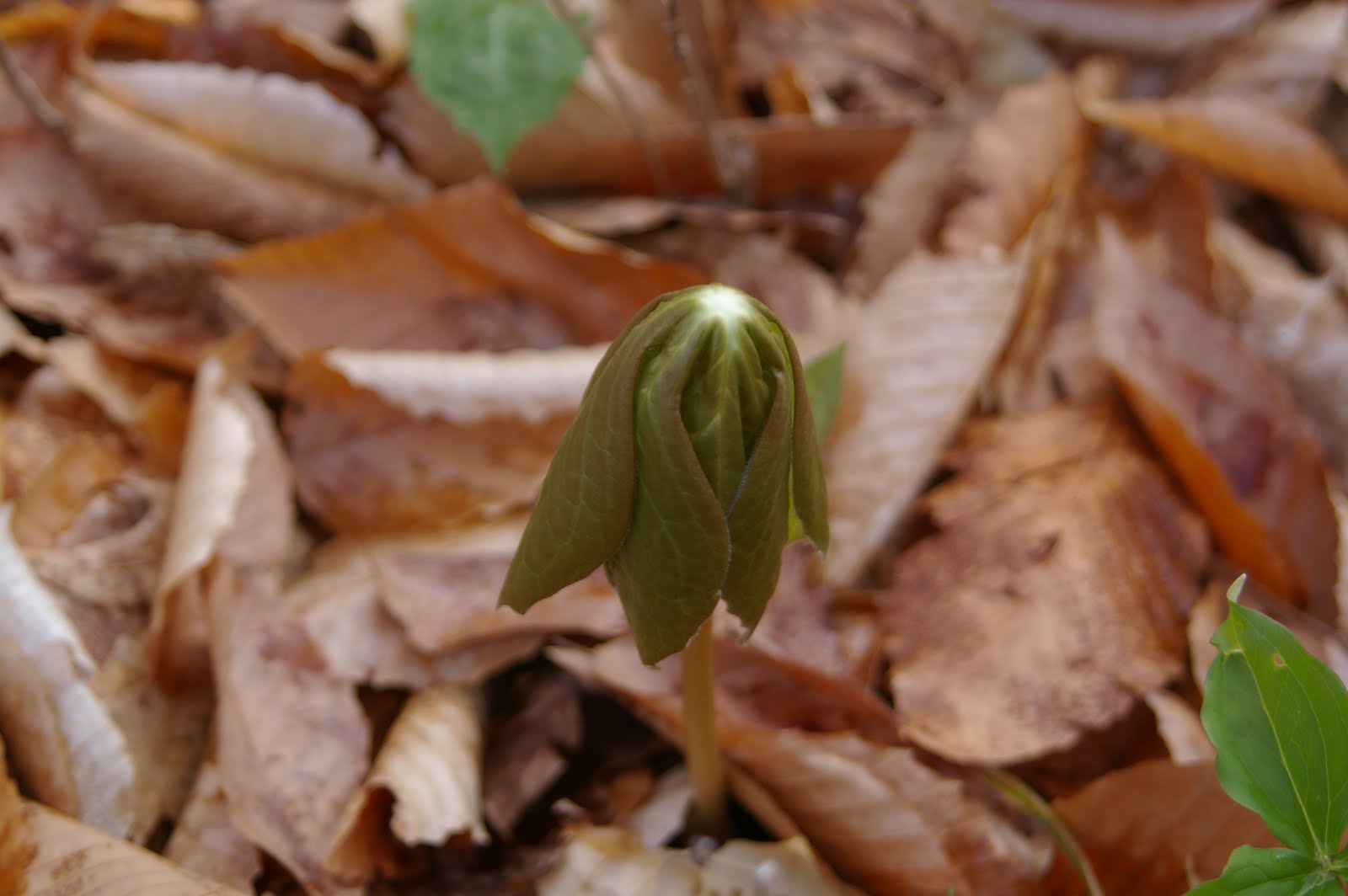
Mayapples unfurl like umbrellas to shade the forest floor.

Sunday, April 11, 2010

Cycles

Shrubs and trees explode in color. Forest flowers open to the unrestrained sun even as leaves emerge from tight buds to eventually shade out the forest floor. Everything is so familiar to me despite the three seasons we’ve been through since then. The script is the same even when the players differ.

That’s true in broad strokes. Late snow cover, early warm days – you can ignore climate change and still the stresses on living things are always at least subtly different this year from last year. Our feelings on the climate are skewed by the present, but trends can involve decades and more. So-called hundred year floods influence real locations of nutrients and plants. Our understanding is limited by the time frames individuals operate on, and since we may not experience rare events multiple times in our lifetime (or our working adult life) we’re often surprised by happenings that are frequent on a geologic time scale.

Crucial events often happen quickly, rarely, and in random places. Predation is like that. So many adaptations are meant to avoid predation, yet actually observing one animal killing another can take a lot of work and luck. Especially with larger carnivores which need to eat less often than a phoebe catching bugs out of the air. The only evidence left may be tufts of bloody fur, clumps of plucked feathers, or unpalatable dragonfly wings as delicate as gossamer.

The world around us is shaped by unseen events and the long-term action of natural laws. History echoes in DNA, dramas played out over eons. Species dance together, for example flowers and their pollinators. Sometimes both groups mutually benefit from their interactions and sometimes one group tries to gain unfair advantages. Other dances are purely antagonistic, like when plants develop defenses to ward off herbivores. Even here competition can become cooperation, as when the toxin caffeine causes humans to spread coffee plants across the tropics.

The history explaining why a community lives in a specific area is also grand compilation of individual stories. Skunk cabbage seeds are swept along by streams, aspen seeds on the wind. Shakespeare enthusiasts import European starlings which now flourish in our fields and cities. Ants carry trillium seeds along through the forest. The world around us has always been in flux, just sometimes in more extreme ways than others.

Saturday, April 3, 2010

Watching

Spring wildflowers in the forest hide in plain sight. I only recently started to notice the pale hepaticas among the ubiquitous mud and leaf litter. Fortunately the bumblebee that whizzed by me this morning is not working with the same color spectrum that we see. Insects are the desired audience for these flowers, but the single trout-lily leaves popping up everywhere have no need to attract attention. They leave that drama to their older or just healthier compatriots.

The pleasure of spring flowers strewn like tiny gems across the landscape is worth a closer look, but birds make it easier to watch them this time of year. Males of different songbird (not a technical term) species are walking that fine line between advertising their presence and avoiding predators. Many dress in eye-catching plumage, or at least spiff up their non-breeding plumage so that, for example, male robins sport a darker head and breast. There are always variations – eastern phoebes are little gray and off-white birds that don’t even bother differentiating the plumage of males and females. However they make up for it with their insistent singing of their own name: “Feebee!” This is another way songbirds draw our eyes, by singing species-specific songs from relatively conspicuous perches. I say relative because finding a flycatcher that is about the size of a cell phone in a mess of branches or bramble is not always an easy task.

We’re not the intended audience here either, and sometimes we can be ignored when too males are locked in showy combat. Recently I was able to walk close to two red-winged blackbirds that were going at each other with noisy wing beats. They tumbled about some cattails then spilled out onto the foot path where they irritated a robin so much that he joined in the fight and chased them off.

Most of this is drama, not violence. Individuals bluff and test each other to determine who has control of what resources. Eventually both the singing and the fighting will calm down as neighbors settle in and mostly ignore each other. Until then, there’s plenty for us to observe. Most of our warblers haven’t even arrived yet – not to mention all the trout lilies, trilliums, mayapples, and other flowers I’m looking forward to seeing soon.

Saturday, March 20, 2010

Happy Spring

It’s the vernal equinox today. Day-length is changing more rapidly now than it will for another half of a year. Everything else seems to be changing quickly as well. Snow has been banished from most surfaces, leaving a flattened landscape littered with the debris of winter. Chattering flocks of red-winged blackbirds descended on the wetlands at work. Their “kon-ka-reeee” joins with the songs of cardinals, robins, song sparrows, and others as they try to carve out a territory nice enough to entice one or more females to settle down within their sphere of influence.

Echoes of the winter remain. The ghostly corpses of tadpoles lie at the bottom of the muddy inlet that feeds the pond at work, reminders of the January thaw and subsequent refreeze. We haven’t all made it this far, but those of us that have are energized by the increasing amounts of sun and warmth. Chipmunks traded their hypothermic torpor for manic runs through the leaf litter, on the lookout for mating opportunities. Moths slip into the house at night and mourning cloaks, a butterfly species, rise from the driveway when we pass.

For those of us in the northern hemisphere who divide our year into quarters, the vernal equinox is the official start of spring. But every creature is using different criteria to try and perform their life functions at the optimal time. Red maple flowers emerging from their buds, but the more precious leaves will stay tightly bound until the threat of an early spring snow is over. Organisms cannot safely start some processes on the basis of warmth alone. Thus many species have internal calendars just as they have internal clocks. Our absent song birds must leave their wintering grounds early enough to arrive, set up shop, breed, brood, and hatch their offspring in time to raise those hungry mouths on the abundant insects that are coming.

Non-humans don’t know the calendar date, but it seems to me they “know” the time of year in a more full-bodied way than we do. We have relatively weak seasonal responses. Our energy lifts, but we don’t enlarge our reproductive organs like many birds. The mild-mannered robins that flocked all winter have grown testy. They sing long, warbling songs as they perch bold and red in bare branches. The songs are announcement and challenge, and it’s not uncommon to see males going at each other with fluttering wings. They’re trying to establish their territory before the females show up. There’s plenty more changes on the way.

Wednesday, March 10, 2010

There are cracks in the icy armor of winter. I've seen them plunge deep into a frozen pond, or expose the gray asphalt of a parking lot. The higher landscapes are still snowbound. In the valley, Gorgeous City lies exposed, its remaining snow confined to piles along edges. Ornamental flowers break through to raise pert little buds to the sky. Rainclouds lurk on the horizon, but for now birds clatter and sing among the barren branches.