Thursday, October 11, 2012
Wednesday, September 26, 2012
Autumn is almost a week old and the
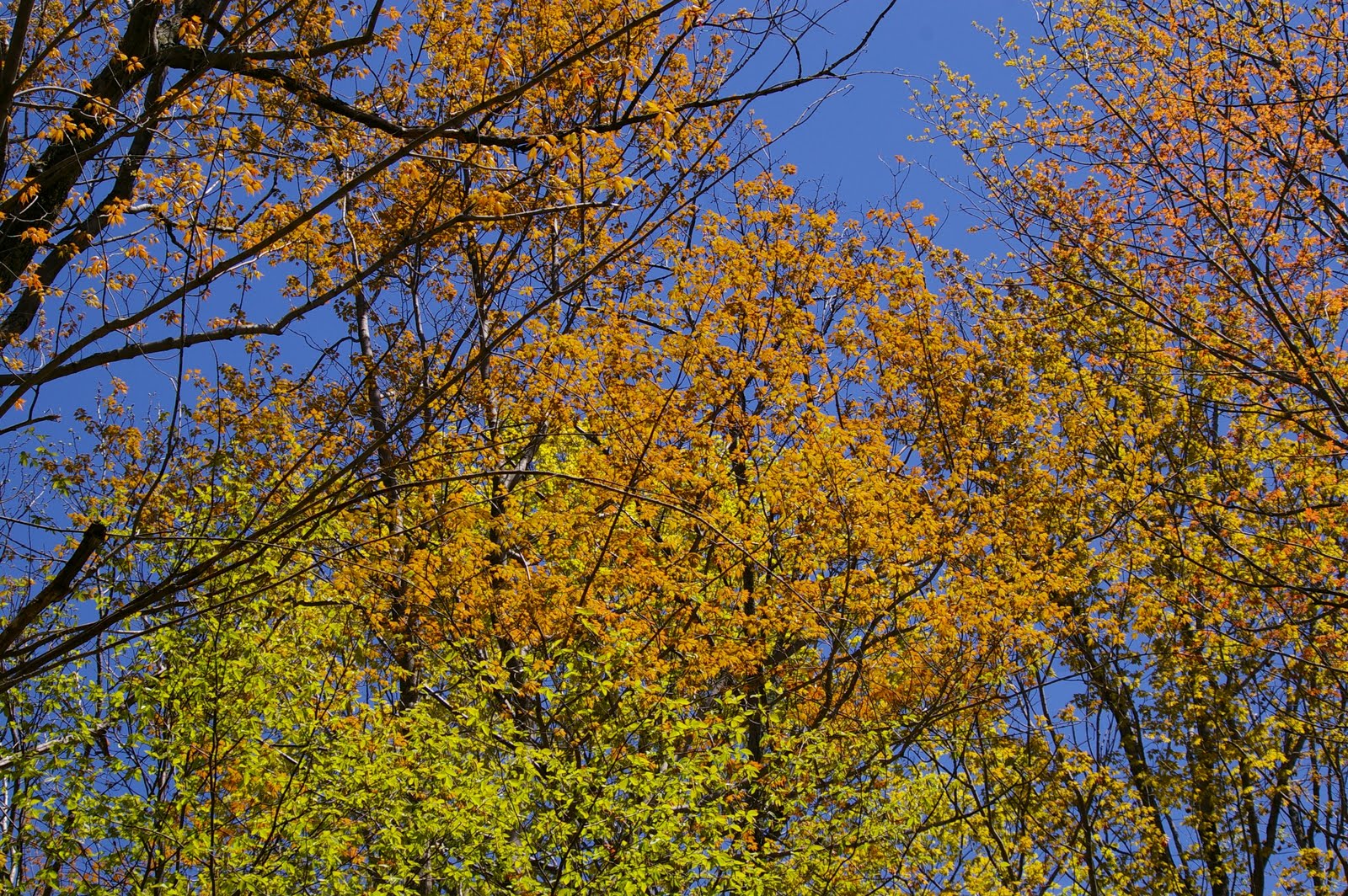
fall color palette is slowly filling in. Here and there single trees
or even branches blaze red or orange against a muted background.
Winds blow in a shifting landscape of weather.
A couple hours after the autumnal
equinox, I took another walk from work. I was feeling the need to
stretch my legs and think, so instead of a leisurely meander along
the shore I headed out for the denser forest at the far end of the
pond. The braver painted turtles craned their necks to watch me walk
by.
A bevy of chipping cardinals cheered up
the undergrowth of young forest along the trail. The emphatic song of
a phoebe rang out over the pond, as if he were preparing to renest
rather than to head south of the Mason-Dixon line. Human noise from
either a radio or some sort of carnival also carried from the same
direction. The distance distorted the original words and washed them
of meaning.
Where the trees became older, a doe
stood at the side of the trail. When I stopped, she first started
toward me very purposefully before veering away. While keeping an eye
on me, she picked up an oak branch bristling with large green leaves.
One by one they disappeared down her gullet as the rest of the
foliage shuddered. She continued into deeper brush and had left no
trace by the time a middle-aged human couple passed by.
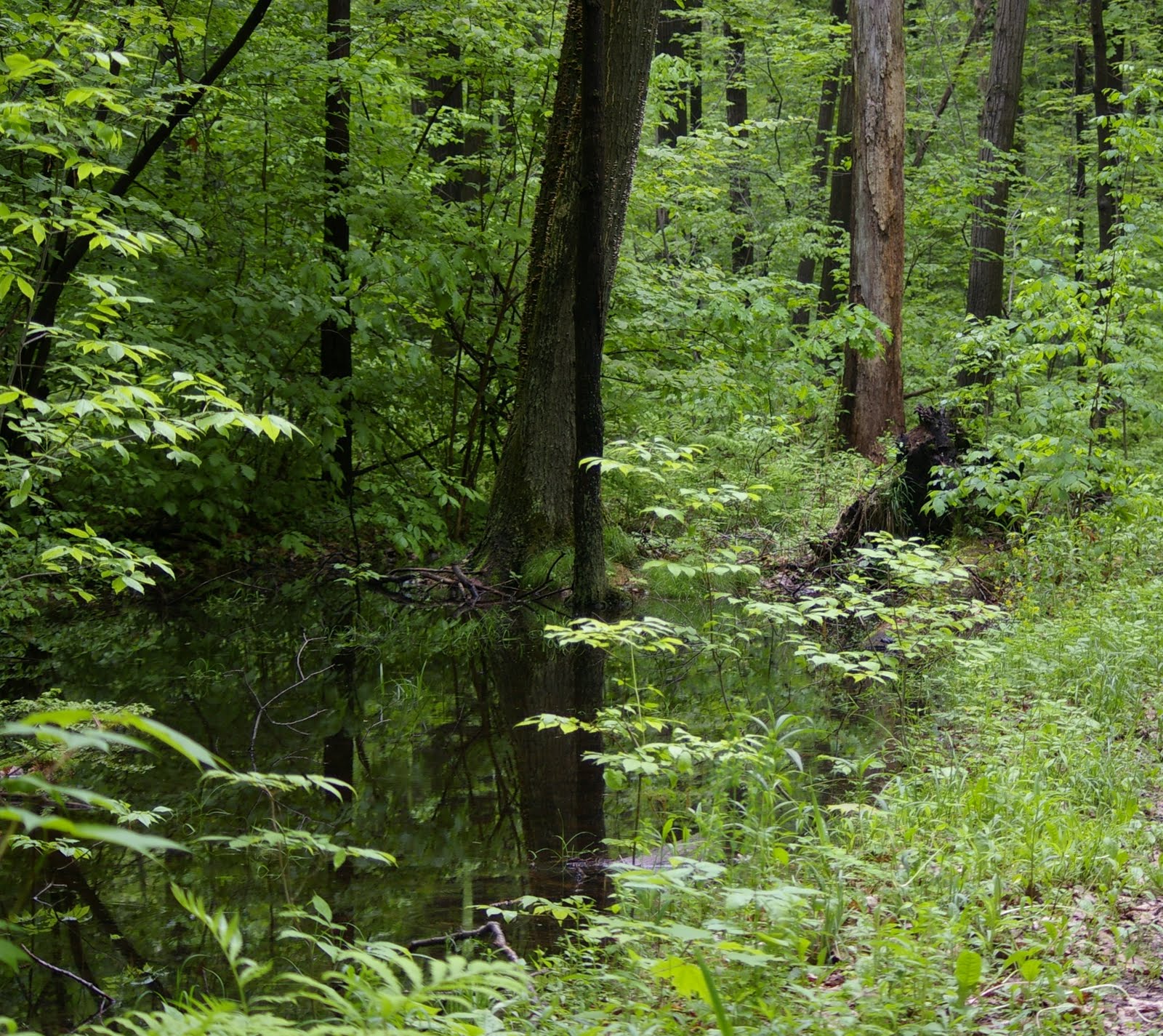
I entered the inner sanctum of the
older forest and slowed. The canopy above was still vibrantly green,
the color enhanced by an earlier soaking rain. The leaf litter was
sparse from a summer of decomposition. Here and there were healthy
patches of poison ivy, grass, and ferns just beginning to yellow.
Beech drops added brush strokes of ochre. A squirrel carried an acorn
across the trail and back onto the uneven forest floor. It traversed
a mostly straight path, veering twice to travel the expressways
provided by fallen logs.
A chipmunk crouched at the apex of a
different converging highway of fallen branches. It was continuously
calling “chup” in a voice that originally had me looking for a
frog rather than a mammal. I disturbed it and it disappeared with a
soft stream of chittering, but as I walked away I could hear the
chupping resume behind me. In a few minutes I encountered another
chipmunk chupping from where it perched on the edge of a beech log.
I assumed these two were males
declaring territories, the pattern most familiar to me from
birdwatching. Later I read that this continuous calling can function
like an air raid siren warning of aerial predators. I wish I'd known
to look up for hawks. Sometimes it feels like there's so much to
learn, and I only sense part of the picture, distorted like the radio
noise. We humans can barely even smell, yet so much mammal and even
insect communication is olfactory.
I was nearing the end of my break by
the time I stepped onto the boardwalk that led back to work. I passed
a different middle-aged couple with binoculars pointed way up into
the tree tops. At least one warbler danced a tango with branch tips
as it foraged for insects. I didn't have time to identify the species
or search for more, which would have been vexing if I was a true
birder. For me, I saw enough for it to be evocative of fall migration
in a bird sanctuary.
Monday, September 17, 2012
The earth is hurtling towards that
point in its orbit where long days tip towards long nights. Summer
will turn to autumn in human terms, but other species experience more
gradual transitions. Last week at work, I took a walk with a late
summer score on a day cooled by intermittent clouds. The forest
buzzed with cicadas. Foraging birds chipped among branches and
startled chipmunks panicked in streams of high-pitched chirps. I
passed underneath a worried gray squirrel. It twitched its tail while
incessantly calling out a raspy alarm. When I returned ten minutes
later, the squirrel was still calling and had even acquired a curious
catbird who screeched replies from the underbrush.
I approached the pond and triggered a
medley of soft ker-plinks. Rows of painted turtles lined logs near
shore in their quest to soak up solar energy. I continued to watch as
the turtles drained away. Singly or in groups they lost their nerve
and slipped under the water. One little turtle skidded across a lily
pad before disappearing.
The bullfrogs were much braver, or at
least trusted in their camouflage. I saw them everywhere once I began
looking - like frog statues tucked in green water among sticks and
lily pads or up on shaded bits of shore. The waning solar energy will
eventually cause both species to seek shelter on the bottom of the
pond.
Wednesday, September 12, 2012
It looked as if a piece of bird
dropping had formed a miniature snake head on one end. We had just
exited the garden when I noticed the caterpillar glistening on a leaf
like the bird poop which it resembled.
Two year-old Daughter was in my arms
yet again, her insistent “Up!” having reminded me that humans are
a species with high parental investment. She asked me if she could
touch the caterpillar (no, I didn't trust her fine motor skills not
to squish it), and whether it was “chilling out” (yes, I supposed
so, although I'm ambivalent about the slang she's picked up from my
casual speech). Still, I couldn't resist prodding the little thing
with a dried leaf. Little orange prongs flicked out like a forked
tongue.
Given nature's inordinate fondness for
beetles and other six-legged beings, my insect ID books only cover a
small part of the diversity surrounding us. Fortunately this species
was one of the handful of caterpillars pictured in my butterfly book.
One phase of the spicebush swallowtail caterpillar resembles
excrement, but in the next phase its snake head becomes useful. By
now it has probably rolled itself into a leaf where it's lurking like
a tiny green snake.
This is a good time of year to
appreciate our arthropod neighbors before the turning seasons
decimate their numbers. We still have a post-it note warning
“Spider!” at our front door, where a beefy red spider had been
making magnificent webs across the door frame every night before
giving up and moving elsewhere. The yellow jackets living next to my
mother-in-law's porch enter and leave their underground nest in a
steady stream. Woollybears crawl through the grass and leaves on
inscrutable errands, preparing to spend the winter in a frozen state.
Daughter can touch these, and enjoy the simple childhood pleasure of
watching them curl into bristly doughnuts. My own fond memories are
colored by their tendency to pee when picked up by clumsy hands.
Sunday, August 26, 2012
Cultural connections
Saturday, July 7, 2012
| Rose-breasted grosbeak on a window feeder |
The next generation of birds has taken
wing. Yesterday the rose-breasted grosbeak that visits our window
feeder brought, or at least led, two juveniles to our backyard. At
least one was a male, dashing in browns rather than the black suit of
his father. Dad chased his future rival a couple times before they
all flew away.
Young birds were everywhere when I
jogged this morning. A heavily-spotted juvenile robin stared at me
from a shrub. I passed flocks of blackbirds that have lost the
anchors of their nests and now dot fields, trees, and power lines.
Individual birds drained off into the air as I ran, like water
dripping at cross-purposes with gravity. Swallow families made a long
row on a power line. One blackbird industriously harassed a
red-tailed hawk, which the perching hawk did not deign to notice,
before returning to a group.
Down the road, a second adult red-tail
on a different utility pole had an apprentice, a juvenile perched
just below. Its colors were muted so that the overall impression was
shades of gray rather than the rusty tint of its parents. These hawks
were probably searching for a mammal, but an unwary bird always makes
a nice snack. Young birds tend to be more clumsy and less wary than
their elders. My casual observation has been that they seem more
likely to be killed by cars or by hitting windows.
Cats lurk along the edges of the
morning, another trap for the careless. One pudgy tabby crouched in a
ditch staring at me, trying out the “you don't see me” Jedi mind
trick. One “cat” became a gray fox trotting down a dirt road
lined by trees. The silvery fur and black striped tail of this native
canine was a nice treat for me, but to the birds it's just another
possible predator.
Tuesday, June 19, 2012
| Just playing. |
I was still groggy from bed, but I have to admit it wasn't very early. The Virginia opossum must have been making a late morning of it. I had just started drinking coffee when I took the dogs out. Ivy was loose and Bear was leashed. It took me a second to realize that the large, gray fur ball Ivy found in the woods was not a cat, and then it took me a second too late to realize that getting close enough to grab Ivy meant Bear was close enough to grab the possum. Fortunately his grip was weak and when he tried to shift it, I was able to drag him back inside. After a few barks of tough talk, Ivy was happy to follow. We left the body slumped in the driveway.
The possum, while far less picturesque than the jumping mouse, looked just as convincingly dead. I grabbed my camera and returned without the dogs. “Don't mind the paparazzi,” I murmured as I snapped pictures from several angles. It twitched its lips a couple times to bare sharp teeth, suggesting that it had a few other defenses in case I didn't leave the poor corpse alone.
Possums seem to me like beasts that have lumbered out of the Mesozoic era, or at least The Princess Bride. Primitive traits, like primitive special effects, aren't always a hindrance. Possums make up for what they lack in agility and brain size by excelling at appearing unappetizing.
We all watched the heap of possum through a window. After a few minutes, it blinked, then raised its head to look around. The entire body rose from the dead and it beat a surprisingly hasty retreat to the depths of the wood shed beside the house. I marveled at its cunning, however innate.
After all, I long ago accepted that if my survival required me to be strong, fast, and above all quick-witted, I probably wouldn't still be here.
Friday, June 15, 2012
Saturday, January 7, 2012
Reading the landscape
We’ve banned our dog Bear roaming free because of a chicken fetish, but on a recent morning he burst through the door and became a black streak moving through the woods. I deposited the toddler with Mama and gave chase. Occasionally I’d glimpse him joyfully racing back and forth through the browns and dark greens. When I finally caught up with him, he was standing over a dead buck sporting a bullet wound.
Slowly and carefully I approached, leashed him, and pulled him away. He seemed too overwhelmed by the munificence of the universe to protest as I took it away. That seems like an interesting metaphor, but for what I’m not quite sure.
Later, as I watched a downy woodpecker bob and dart around a spruce tree, I thought about the different ways we read the landscape. As a descendent of fruit-seeking primates, my eyes are drawn to remnants of color. As a domesticated human, my needs are more emotional than physical. I see beauty in the patterns made by the exposed roots of a tip-up, where a rabbit would see shelter from threats like our dogs. I can’t hear if insects are active beneath tree bark like the woodpecker can. Farther on I find piles of discarded spruce cones, their bracts closed tight but empty of seeds underneath. Around the tree trunk is a thick pile of bracts and stripped cones. I couldn’t have known that these had had seeds while the others were a waste of time just by smell, like the squirrels did.
The day was cool and overcast, with a hint of rain that never managed to fall. Distant crows cawed and squirrels rattled. Humanity moved about in the background noises of cars and planes. It was mid-day, but owls briefly sang their melancholy songs, contributing to a feeling of fading light. If humans had better senses or if the temperatures were much higher, the whole scene would have been permeated with an odor of death. Not being a scavenger, that would not be a joyous thing for me.
Slowly and carefully I approached, leashed him, and pulled him away. He seemed too overwhelmed by the munificence of the universe to protest as I took it away. That seems like an interesting metaphor, but for what I’m not quite sure.
Later, as I watched a downy woodpecker bob and dart around a spruce tree, I thought about the different ways we read the landscape. As a descendent of fruit-seeking primates, my eyes are drawn to remnants of color. As a domesticated human, my needs are more emotional than physical. I see beauty in the patterns made by the exposed roots of a tip-up, where a rabbit would see shelter from threats like our dogs. I can’t hear if insects are active beneath tree bark like the woodpecker can. Farther on I find piles of discarded spruce cones, their bracts closed tight but empty of seeds underneath. Around the tree trunk is a thick pile of bracts and stripped cones. I couldn’t have known that these had had seeds while the others were a waste of time just by smell, like the squirrels did.
The day was cool and overcast, with a hint of rain that never managed to fall. Distant crows cawed and squirrels rattled. Humanity moved about in the background noises of cars and planes. It was mid-day, but owls briefly sang their melancholy songs, contributing to a feeling of fading light. If humans had better senses or if the temperatures were much higher, the whole scene would have been permeated with an odor of death. Not being a scavenger, that would not be a joyous thing for me.
Sunday, January 1, 2012
Saturday, December 17, 2011
A few days ago, I had the luxury of a long walk without the toddler or the dogs. The forest has been stripped down to the bleakness of winter, which officially starts next week. Deceptively delicate featherings of moss claimed the unwanted surfaces – rocks and wood. Reproduction is always in progress somewhere. The fawns which are forming inside does represent high maternal investment, while the clusters of seeds held aloft awaiting their turn for dispersal are much cheaper.
Insects crawled and stumbled about in the sun-warmed leaf litter. The forest was still waiting for a festive carpet of snow to shield the forest floor and its occupants from the shifting weather and temperatures (today the air is dotted with snow, making a thin covering that’s rough with leaves and spiky grass).
Casual birding is a feast or famine enterprise depending on where the mixed feeding flocks are foraging or where the crows are congregating. My walk was without avian accompaniment, until I remembered that there are almost always a few patrons at the bird feeder next door. A fact not always lost on the nonhuman forest residents who are interested in song birds. Woodpecker and nuthatches hung back in the woods, while bolder chickadees shuttle back and forth through the yard. Then some titmice appear. To me, titmice suggest mini jays in attitude and headdress.
Thursday, December 1, 2011
In late fall and early spring I can almost convince myself that green is a shade of brown. Moss, ferns, and perennial plants abound, but the listless leaves of the latter two manage to suggest barely more life than the brittle goldenrods, now cast in bronze and topped with wool. Our evening walks sometimes spook turkeys from their roosts high in the trees. Heavy wing beats and crashing branches draw my eyes up for a glimpse of large bodies in silhouette. Day walks pause when the dogs notice the spectral gray squirrels floating up trunks in complete silence. When I walk without the dogs, I hear the squirrels cry and quarrel among themselves. Sporadic crow conventions convene in the back woods and add bleak vocals to the gray and brown scenery.
We’re in the midst of hunting season. The heavy fire days are holidays and weekends, but we’re always a little tense because of the ever present possibility of isolated shots. Not as tense as the deer. One morning we found bright blood splattered on brown leaves by the driveway, evidence of a wound which we assumed to be hunting related. The deer move more quietly than squirrels, and what we do see of them tends to be gray patches moving through thick curtains of intervening trunks.
This week I had a short time available to walk through a wildlife preserve with my camera. I rounded a corner to find two mother deer with their nearly-grown fawns grazing by the side of the path. With slow movements I took out my camera and stalked forward. After a few glances in my direction, most of the group resumed eating while one youngster fixed me with a picturesque gaze. I clicked – only to discover that my battery was dead. Frustrated at losing this opportunity which I knew would be near impossible on our land, I rushed back to the visitor center where I plugged the rechargeable batteries into a power outlet. For five minutes I hoped the deer hadn’t moved very far, given that my free-time was draining away. Then I grabbed all my gear and headed back out.
I shouldn’t have worried. The placid deer were now grazing right next to the building.
We’re in the midst of hunting season. The heavy fire days are holidays and weekends, but we’re always a little tense because of the ever present possibility of isolated shots. Not as tense as the deer. One morning we found bright blood splattered on brown leaves by the driveway, evidence of a wound which we assumed to be hunting related. The deer move more quietly than squirrels, and what we do see of them tends to be gray patches moving through thick curtains of intervening trunks.
This week I had a short time available to walk through a wildlife preserve with my camera. I rounded a corner to find two mother deer with their nearly-grown fawns grazing by the side of the path. With slow movements I took out my camera and stalked forward. After a few glances in my direction, most of the group resumed eating while one youngster fixed me with a picturesque gaze. I clicked – only to discover that my battery was dead. Frustrated at losing this opportunity which I knew would be near impossible on our land, I rushed back to the visitor center where I plugged the rechargeable batteries into a power outlet. For five minutes I hoped the deer hadn’t moved very far, given that my free-time was draining away. Then I grabbed all my gear and headed back out.
I shouldn’t have worried. The placid deer were now grazing right next to the building.
Friday, November 4, 2011
Friday, October 28, 2011
On a recent afternoon I enjoyed a peaceful interlude while the baby napped upstairs. I sat at the table and watched the backyard through the frame of the picture window. It was cold inside, but colder out, and everything felt slightly damp. It’s that time of year when a fire often seems overkill, but fortunately there are plenty of apples and pumpkins for baking to give the house a touch of warmth and spice.
Dampness darkened the colors outside. The understory glowed against the gray sky. Taller trees stood mostly bare, although a few canopies were still fleshed out. Sparse leaves quivered, sometimes breaking into a free-fall that attracted the eye. Similar movements resolved into birds, betrayed by speed or defiance of gravity.
After I watched for a while I realized the backyard was a busy place. A chipmunk ran across, posing for a second on the seat of an Adirondack chair. A red squirrel traveled in spurts up a tree trunk, its tail changing constantly from flat and calm to up and agitated. Suddenly it turned around and retreated for no obvious reason. Winter birds such as titmice and jays moved among the branches. A golden-crowned kinglet flitted among spent goldenrods, its flash of yellow like a visible comment. At the table I was surrounded by house noises. Propane bubbled in the workings of the refrigerator. The house spoke in a low hum like silence given voice, interrupted by one of our cats purring contentedly as she tried to either obstruct my view or step on my writing. Outside I knew I would hear the jays calling, crows cawing, and a cardinal or two chipping in the brush.
Migrating birds were still present. A gray catbird tumbled among the young trees surrounding the garden. Yellow-rumped warblers flashed their butter-butts. Two hermit thrushes patronized the large pokeweeds decorating the yard with still-green leaves and, more importantly, fat purple berries. For the migrating birds this was a respite from travel, though not without its dangers. My mother-in-law’s cats lurk in the underbrush, when they’re not hiding from the weather in her house. Our house has plenty of windows to confuse a startled bird. I wondered for a moment if the birds felt adrift in a hostile world, but “home” is a concept for those of us who build and use shelters. Even our winter residents will live a transient existence in search of food.
Thursday, October 20, 2011
It would have been a great picture. The handsome mouse lay curled in on itself, like the woolly bear we showed to the baby later in the day. Its lower body was white, its sides golden brown, and a dark band followed its back. I didn’t take its picture, though, because I thought I might have killed the creature with my shovel.
I had been moving topsoil from a pile to a new flowerbed. When I dumped the load, the mouse emerged like form from nothingness. Neither fear nor breath moved the body, except… maybe there was a twitch. Or just the way one’s eyes create movement when held still for too long. I gently turned the mouse over but could discover no wounds in the supple body. Maybe the damage was all internal? As far as I knew, our mice don’t hibernate. Even our chipmunks, which do, are still foraging, filling the woods with chirrups and rustling leaves.
I could still take a picture of a dead mouse, but it doesn’t feel right. Not one that I’ve killed directly or indirectly. There’s a sense of exploitation, or disrespect. Telling the story feels different, since the part I’ve played is firmly in place rather than off screen. As for giving meaning to an accidental death, the idea of not wasting death is a human one, not a comfort to the dead creature itself. It’s interesting that humans attribute such feelings to fellow creatures, when most humans in life or death situations would happily take the bastards down with them. It is also not a woodland idea, where death is savored by assorted creatures from the large to the microscopic.
I removed the body to the base of a rotting stump. It began to pulse in on itself, but even with this sign of life (or at least electrical activity) I resisted a picture. The movement reminded me of birds that have fatally injured themselves on windows. I left it alone to its fate, because a predator is not a comfort to the dying.
It was gone when I returned, and I realized I could have taken the picture guilt-free.
Later I was able to fill in my information gaps with our reference books. The rodent was technically not a mouse but a jumping mouse. Woodland jumping mice hibernate about half the year, which would account for the early internment. They are common yet rarely seen. So I probably won’t have another chance.
I had been moving topsoil from a pile to a new flowerbed. When I dumped the load, the mouse emerged like form from nothingness. Neither fear nor breath moved the body, except… maybe there was a twitch. Or just the way one’s eyes create movement when held still for too long. I gently turned the mouse over but could discover no wounds in the supple body. Maybe the damage was all internal? As far as I knew, our mice don’t hibernate. Even our chipmunks, which do, are still foraging, filling the woods with chirrups and rustling leaves.
I could still take a picture of a dead mouse, but it doesn’t feel right. Not one that I’ve killed directly or indirectly. There’s a sense of exploitation, or disrespect. Telling the story feels different, since the part I’ve played is firmly in place rather than off screen. As for giving meaning to an accidental death, the idea of not wasting death is a human one, not a comfort to the dead creature itself. It’s interesting that humans attribute such feelings to fellow creatures, when most humans in life or death situations would happily take the bastards down with them. It is also not a woodland idea, where death is savored by assorted creatures from the large to the microscopic.
I removed the body to the base of a rotting stump. It began to pulse in on itself, but even with this sign of life (or at least electrical activity) I resisted a picture. The movement reminded me of birds that have fatally injured themselves on windows. I left it alone to its fate, because a predator is not a comfort to the dying.
It was gone when I returned, and I realized I could have taken the picture guilt-free.
Later I was able to fill in my information gaps with our reference books. The rodent was technically not a mouse but a jumping mouse. Woodland jumping mice hibernate about half the year, which would account for the early internment. They are common yet rarely seen. So I probably won’t have another chance.
Tuesday, July 12, 2011
Life in the woods has been busy since I last posted. I’ve been busy with a different project, which I hope will bear its own fruit in time.
The floating auras of mosquitoes which one acquires in our woods have been reduced, although they’ve been supplemented by the flies which zip around our head and occasionally bury themselves in our hair. I try to always remember a hat so I’m not constantly running my hands over my head. Back in June I almost walked into a spider web. I bent down to watch the spider tend to a long-legged fly. A mosquito hovered into view and I automatically blew it away, right into the web. She flew this way and that, seemingly about to break free, but then the spider hustled over. It spun the mosquito around while wrapping her in silk. Finished, the spider settled down between its two prizes. I left with a small feeling of satisfaction.
Many, though not all, of our migratory birds are also engaged in eating insects. The forest is still filled with bird sounds, but much less of them are songs. Bird families keep together with chatter as they forage. The robins in the woodshed fledged in mid-June. Three fat robins were crowded into the nest one day and the nest was empty the next, the wall white-washed with droppings. A raucous family of titmice has been patronizing the feeders at my mother in-law’s house since about the same time. The cats and the baby get very excited at their fluttering arrivals (“Bir! Bir!).
Blackbirds no longer tied to a nest are shifting around the landscape in large flocks. When we walk in the evenings, they move overhead from forage to roost in waves of clouds, if I may be allowed to mix metaphors. Flocks of grackles regularly invade patches of the forest. The woods come alive with them moving from ground to tree to tree in every direction, brown young birds with a faint sheen mixed with their iridescent elders. Suddenly the balance shifts and they blow through like a wind as they leave.
The floating auras of mosquitoes which one acquires in our woods have been reduced, although they’ve been supplemented by the flies which zip around our head and occasionally bury themselves in our hair. I try to always remember a hat so I’m not constantly running my hands over my head. Back in June I almost walked into a spider web. I bent down to watch the spider tend to a long-legged fly. A mosquito hovered into view and I automatically blew it away, right into the web. She flew this way and that, seemingly about to break free, but then the spider hustled over. It spun the mosquito around while wrapping her in silk. Finished, the spider settled down between its two prizes. I left with a small feeling of satisfaction.
Many, though not all, of our migratory birds are also engaged in eating insects. The forest is still filled with bird sounds, but much less of them are songs. Bird families keep together with chatter as they forage. The robins in the woodshed fledged in mid-June. Three fat robins were crowded into the nest one day and the nest was empty the next, the wall white-washed with droppings. A raucous family of titmice has been patronizing the feeders at my mother in-law’s house since about the same time. The cats and the baby get very excited at their fluttering arrivals (“Bir! Bir!).
Blackbirds no longer tied to a nest are shifting around the landscape in large flocks. When we walk in the evenings, they move overhead from forage to roost in waves of clouds, if I may be allowed to mix metaphors. Flocks of grackles regularly invade patches of the forest. The woods come alive with them moving from ground to tree to tree in every direction, brown young birds with a faint sheen mixed with their iridescent elders. Suddenly the balance shifts and they blow through like a wind as they leave.
Wednesday, June 22, 2011
Friday, June 10, 2011
Last year, the day before my partner went into labor, we walked a forest trail with tall groves of cinnamon and interrupted ferns. This year we wanted to recreate that hike with the baby in tow, which we did last week. It was even more beautiful than I remembered. If there were a color called royal green, it would be found in the late spring woods. Pools contemplated still reflections. Unfortunately they also had hosted the mosquito larvae that turned into the hordes of adults now hovering around us, waiting for any chance to alight on exposed flesh. We belatedly remembered that last year had been a dry spring, and after ten minutes one of us said, “That was nice. Shall we go home now?”
If we had less summer invertebrates, there would be less breeding birds. There are plenty which don’t want my blood to fuel their reproduction, which I appreciate. I like to watch little native bees with pollen panniers and spiders lurking in grass caves. Fireflies add a touch of elegance to the darkening woods, especially if I don’t think of Disney’s Magic Kingdom. A few days ago I played paparazzi to the flashier side of the arthropod world, butterflies and damselflies sunning themselves along the driveway.

Banded purple

Ebony jewelwing

Mourning cloak
If we had less summer invertebrates, there would be less breeding birds. There are plenty which don’t want my blood to fuel their reproduction, which I appreciate. I like to watch little native bees with pollen panniers and spiders lurking in grass caves. Fireflies add a touch of elegance to the darkening woods, especially if I don’t think of Disney’s Magic Kingdom. A few days ago I played paparazzi to the flashier side of the arthropod world, butterflies and damselflies sunning themselves along the driveway.
Banded purple
Ebony jewelwing
Mourning cloak
Monday, May 23, 2011
The summer visitors have settled in among the residents, at least in the bird community. Migrating birds have to arrive early so their young can be laid and incubated before the halcyon days of late spring, early summer. There’s a robin mother tucked in to a nest outside our window, the circle of white around her eye making her look watchful.

[Trillium]
Many of the spring flowers have moved on to seeds and fruit. Trilliums flowers sag and many dandelions sport tiny supernovas. Dandelion flowers still dot the lawn, and wild geraniums grace the forest. Foamflowers float above the litter of the forest floor.

[Dandelions]

[Wild geraniums]

[Foamflowers]
[Trillium]
Many of the spring flowers have moved on to seeds and fruit. Trilliums flowers sag and many dandelions sport tiny supernovas. Dandelion flowers still dot the lawn, and wild geraniums grace the forest. Foamflowers float above the litter of the forest floor.
[Dandelions]
[Wild geraniums]
[Foamflowers]
Sunday, May 15, 2011
I was playing outside with my daughter and I noticed one of my mother-in-law’s cats tossing something furry about. It was a headless juvenile rabbit. I hadn’t noticed the cottontails were well into their reproductive season, an ignorance which the rabbits work hard to foster. The mother hides her helpless young with wood piles or leaves and grass before they’re ready to venture out among their many enemies, which includes both our dogs and cats.
The forest teems with bird movement and songs. Male birds are showy and loud as they acoustically carve out territories and woo fair maidens. Movement to and from nests by either sex is as secretive as possible. I’ve seen lots of quiet birds with bits of straw or other nest material in their mouths. One morning I had set my phone alarm in order to return home for my turn with the baby. When it went off, I heard a flutter of wings right above me. A blue jay hopped away from a mess of sticks to join a second bird nearby. They both proceeded to eye me. I hurried away, leaving them to their reproductive effort while I tended to mine.
I could seek out more nests, but now that I don’t have a field job I find my accidental encounters are enough to satisfy my curiosity. Parents abandon nests more easily than they abandon fledglings, which represent a longer investment of time and effort. Jays and other nest predators have learned during field studies to follow human trails or even watch people and their markings in order to locate nests.
Nest predators are as numerous as the rabbits’ enemies. Eggs and nestlings are convenient protein packages that even squirrels and deer are happy to munch. A brown cowbird often skulks among the young beech trees by the garden, searching for unattended nests in which to deposit her changelings.

[Brown-headed cowbird male (right) displaying for a reluctant female]
Eggs need a resting place for incubation, but chicks come in different levels of readiness. Last weekend my friend jo(e) was visiting. In the morning mist we startled a ruffed grouse, which shot away in an explosion of wings in the hope that we would either be distracted or would at least not eat her along with the twelve perfect eggs tucked into her nest. After admiring them we moved on. If they survive to hatch, twelve little chicks will trail after their mother within a day of hatching, making moving targets for their enemies.
The forest teems with bird movement and songs. Male birds are showy and loud as they acoustically carve out territories and woo fair maidens. Movement to and from nests by either sex is as secretive as possible. I’ve seen lots of quiet birds with bits of straw or other nest material in their mouths. One morning I had set my phone alarm in order to return home for my turn with the baby. When it went off, I heard a flutter of wings right above me. A blue jay hopped away from a mess of sticks to join a second bird nearby. They both proceeded to eye me. I hurried away, leaving them to their reproductive effort while I tended to mine.
I could seek out more nests, but now that I don’t have a field job I find my accidental encounters are enough to satisfy my curiosity. Parents abandon nests more easily than they abandon fledglings, which represent a longer investment of time and effort. Jays and other nest predators have learned during field studies to follow human trails or even watch people and their markings in order to locate nests.
Nest predators are as numerous as the rabbits’ enemies. Eggs and nestlings are convenient protein packages that even squirrels and deer are happy to munch. A brown cowbird often skulks among the young beech trees by the garden, searching for unattended nests in which to deposit her changelings.
[Brown-headed cowbird male (right) displaying for a reluctant female]
Eggs need a resting place for incubation, but chicks come in different levels of readiness. Last weekend my friend jo(e) was visiting. In the morning mist we startled a ruffed grouse, which shot away in an explosion of wings in the hope that we would either be distracted or would at least not eat her along with the twelve perfect eggs tucked into her nest. After admiring them we moved on. If they survive to hatch, twelve little chicks will trail after their mother within a day of hatching, making moving targets for their enemies.
Saturday, May 14, 2011
Subscribe to:
Posts (Atom)