Friday, February 25, 2011

On a calm day in autumn, you can hear the sound of leaves littering the forest floor. On certain summer days, there’s the soft rain of caterpillars pooping. Today a walk outside is accompanied by the plop of clumps of snow, at least those that don’t hit branches on the way down and dissipate in a spray of white.

The morning when most of that snow was deposited on the trees, a titmouse was bravely singing “peter peter peter” among the steady flakes. Birds don’t need to check their shadows to know that spring is coming. They have an internal calendar which is calibrated by the shortening night lengths. Late February sees an increase in bird song, that special vocalizing which birds use to secure territories and attract mates.


[Black-capped chickadee]

The chickadee song of “fee-bee-bee” and “fee-bee” joins the myriad of other vocalizations made by this chatty species. It can be sung year-round by both sexes, but the main use is by males in the breeding season.


[Red-bellied woodpecker]

Woodpeckers drum instead of singing.


[Red-tailed hawk]

Red-tailed hawks use aerial displays for courtship and territorial tasks.

Saturday, February 19, 2011

On leashes

One night this week, Bear needed to go out at midnight. The wind roared and angry gusts crashed through the trees as a warm front pushed our way. We were exhausted both from the baby and from being miserably sick for a few days. We decided that the chickens which Bear loved so much were most likely safe in their coops, so I opened the door and motioned Bear out. It was the first time in over a year that we had given him the opportunity to run free.

He pranced out into the snow, head and tail held high. He pranced a little way in one direction, then the other. As I headed back upstairs we started to have misgivings about giving him the opportunity to go on walkabout. He could easily disappear for hours and we’d start to worry about the chickens being let out in the morning. But out the window we could see Bear still standing in the porch light.

I went back and opened the door, shaking a box of treats. Bear happily trotted inside. I leashed him and we all headed out into the maelstrom.

Saturday, February 12, 2011


One night we emerged from the house next door to find the world laden with snow. Burdened saplings loomed toward us in the beam of our flashlight.

When snow plasters all the branches, it creates a fairy-tale landscape. Though this tale has moved to Russia from the knobby “German” forest of late fall. The woods bristle with texture and close in around the walker. Without snow, the bare gray trees give the impression of an arid land, which is somewhat appropriate because so much water is bound up in snow and ice.

The cloud-like surface of the snow is illusory, accessible only with snowshoes. In boots the deception crumbles step by step, and mounds may be revealed as deep drifts. The plastered branches provide no dry perch for singing finches or chickadees. Fortunately they regulate their legs and feet just above freezing. My body has some designs in that direction – I’m often accused of having cold hands and feet – but it’s not enough to let me go barefoot in the snow.

Monday, February 7, 2011

We’ve had some beautiful clear days to charge up our solar-powered system. One day at lunch I stepped out into the sunshine that was bright and warm on the glittering snow. In the distance, a titmouse sang “peter, peter, peter,” a prelude to the coming breeding season. Fearless chickadees foraged nearby, keeping up a constant chatter. Squirrels cried and one pair on the ground erupted into a brief chase.


The snow cover had a crunchy crust like good bread. Tree shadows lined the forest flour, following the contours of snow that rolled like the plains. An understory hemlock towered overhead and broke up the lines with prickly blobs. Further along, the beech understory still shivered in their retained leaves.

The marshy boardwalk, so open in the summer, now felt like a refuge from the ascendant power of the winter sun. Pines, hemlocks, and spruces surrounded me where the saturated soil retards the growth of deciduous trees that rule the forest elsewhere. The bird life was the same, however, and chickadees fluttered away at their work. A nuthatch in the distance was stuck on repeat as he sang his breeding season song.

Then lunch was over, and I re-entered the office, my vision hazy in the darkness.

Sunday, January 30, 2011

We had some bitter cold this week. The snow creaked under foot on the way into work, and a house finch sang from a nearby tree top. A dark-eyed junco chased a sparrow across the path. Even with long-johns and other modern insulation my body heat seeped away, yet the little birds.

Most little birds survive, anyway, and the exceptions wouldn’t draw attention to themselves. Unlike mice and voles, these birds can’t burrow in the insulating snow to escape from the weather, but they can get under cover of branches. The trees themselves sweep the capricious sky with no recourse to hiding. They rely on thick bark or resin, plus dormancy this time of year.


It’s strange that such radically different beings as darting chickadees and looming red maples are both life. Both share features such as using DNA as their code of life. Death treats them differently, though, and trees often have dead tissue still protruding from live trunks. Even if birds survive the loss of a limb, there’s no way for them to grow a replacement. Birds are also unable to clone themselves after being cut in half, as how certain stumps will be ringed with new samplings rising from the roots.


Like many strengths, our centralized nervous system and highly structured bodies are also vulnerabilities. My fear of falling trees kicks in when the wind gets too feisty and the canopy dances about. At some point something will kill every one of us, even the thick oaks with the protection of being on sanctuary land. Some bacteria may approach an immortality of sorts, and the way plants clone themselves makes the question of their mortality a question of how to define an individual. At least until the sun gives out.

Birds and mammals live such straightforward lives in comparison. We’ve each figured out a basic life cycle and kept the tweaks to a minimum. There are plenty of other traits to vary, like parental investment. That day at lunch I encountered one of the resident mother-fawn pairs near the trail. They stuck their snouts in the snow, searching. Their faces were dusted with white and the young one had a clump of burdock crowning its forehead. Their ears flicked back and forth as they foraged, then aimed back at me as they wandered away. In the sanctuary, the cold is much more dangerous than a human, and even that is pretty manageable with bird feeders stocked with seeds nearby.

Friday, January 28, 2011

Winter neighbors


Blue jay.


House finch with bands on its legs as witness to a previous human contact.


Northern cardinal.


Young white-tail.

Sunday, January 16, 2011

Our winter snowpack is transient. We are rarely in the path of the lake effect snow pulled off of the Great Lake to our north. Snow cover appears and disappears quickly with changing weather.

So it feels special when we walk through a forest that has been dressed in wintry splendor. Bear loves to bound along and suddenly land with all his legs stuck in a snow bank. When breaking new paths, snow shifts under every step, and branches and roots lie in wait. Forward momentum requires a certain amount of vertical force. Instead of the delicate paw prints of weeks ago, squirrel tracks are trenches plowed from one tree base to another.

We have a ghost herd of deer that take cover in the woods all winter. They set the dogs barking in the mornings before fading away. The forest is studded with the depressions their bodies have melted into the snow as they rested. Their visible tracks show us that the dogs’ sudden turns and meanders are not as random as they appear. Noses down, the dogs spoil the network of trails, joyous with their murderous intent which is fortunately never realized.

Sunday, January 9, 2011

I figured my lunch walk at work would be a better venue for trying out my new camera lens. The sun dallied in and out of the clouds, holding out the promise of good lighting. I headed for the youngest section of the forest where lots of birds hang about, attracted by the berries on invasive shrubs or the bird feeders stocked with seeds.

As predicted the birds were numerous. An American tree sparrow flew into the branches above me as I walked. White-throated sparrows and chickadees moved about in the brush. Unfortunately little birds are twitchy. They constantly move as they search for insects and berries or a turn at the feeder, needing lots of food energy to balance the heat which is quickly lost from their little bodies. I lifted my camera to catch a slower moving cardinal, only to discover that the seemingly clear view of him was in reality obstructed by a mass of little branches, all of which the automatic focus tried zero in on rather than on my bird. Sometimes it takes a computer to demonstrate all the complicated tasks our brains perform behind the scenes, like filtering out the irrelevant branches in order to picture the whole cardinal.

I took what pictures I could until the batteries suddenly died. As I stood there, recapping the camera, a red-shouldered hawk flew up into some trees a little ways from me. I put the camera away and pulled out my binoculars to admire the raptor. He or she flew away when I start walking again. Other animals also filter out irrelevant information from the environment. Unfortunately most are aware that humans need to be watched.

Sunday, January 2, 2011

Rain and warmth have vanquished all but a few scattered remnants of our snow. This morning hovered between ice and water. Small branches are decorated with suspended droplets, like a cold counterpart to the first flush of spring growth. Leaves crunch underfoot, kept frozen by the mass of the soil. I step over a border of fertile fronds onto a forest pool. Its sodden ice sags heavily. When I reach the stream I find it flowing merrily over a streambed of ice, which appears frothy from frozen air bubbles.
Lately there’s been a great horned owl fledgling hanging out in our woods. We hear him or her squawking at night as we walk next door or in the morning as I’m leaving for work. When I went out the other morning I heard the hooting of a pair of adults instead.

I went back to grab my camera, eager to try out my new zoom lens. Ivy followed me outside, eager to smell what had happened overnight. Crows had started cawing in the direction we were headed, making it seem that they had found the owls and begun harassing them. But as we walked the owls kept up their duet and the crows were arguing among themselves.

I went slowly, scanning the canopy ahead. We startled a herd of deer, and they fled in a long line of dark figures among the tree trunks. These deer are used to being hunted, while the ones where I work live on a refuge. Sometimes I have to shoo those deer out of my way, which offends them. As their white tails disappeared, the owls stopped. I snapped a few pictures of the snowscape which came out dark and unfocused, then headed back.

Chickadees twittered above me, then disappeared. A goldfinch moved quickly overhead, unseen. Crows flying towards the ruckus in the distance were too high and fast through the branches for my camera to focus on. The winter flocks were foraging elsewhere and I had other things to do. Oh well. The light wasn’t that great, anyway.

Wednesday, December 29, 2010

Outside the sky is a watercolor of clouds, the air is cold but not brutally so. Twigs stick out from the soft carpet of snow. Some are young trees. Others are poison ivy seemingly disarmed but still carrying noxious oil. Dried stalks of herbaceous plants hold viable seed, like the tall goldenrods and asters that edge my garden beds. When I accidentally brush against them, fluff and seeds rain down to lie in wait for the growing season.

Sunday, December 12, 2010

A few days ago a hawk flew overhead as I was driving to town. I assumed it would be a red-tail, but as I got closer I could see the patterning on the wings was wrong. It tilted, and dark patches on its front gave it away as a rough-legged hawk, one of several birds that winter here and are most familiar with our area in its bleak aspect. The species is a refugee from the north through the action of evolution, but individuals experience the brief arctic summer and never see ours.

This past week, the days were below freezing. Freezing in this case refers to the freezing point of liquid water. As I walked along the pond before work, all of us living things were trying to ward off or control the creep of ice. All of us are made up of cells and of large proportions of water, from the white-throated sparrows hiding among shrub branches to the mice and squirrels who made the tracks criss-crossing the pond’s surface. The shrubs themselves have lost their water rich leaves.

When I walked the boardwalk across the street, I half expected my passage to be preceded by shrieking frogs as in summer, but the pools are mostly ice-bound. My footsteps make muffled crunches. Above, trees creak and branches rustle. The red dragonflies which used to alight on the railings have wandered elsewhere. The frogs are tucked away in the bottom of pools deep enough not to freeze solid. They’re taking advantage of the fact that solid water is lighter than very cold liquid water, which sinks to the bottom away from the cold air. Perhaps to them only our growing season is real, while our winter is less than a dream.

Monday, December 6, 2010


Earlier this week, heavy rain turned to heavy snow just in time for my lunch walk. Thick, wet flakes melted into swollen pools or formed sodden ice at the edges. Water coated the bramble. It hovered between liquid and solid with crystals forming along the branches and droplets hanging from the ends.

Wetland pools had redrawn their shores and claimed sections of the path with eddies and waterfalls. I managed to soak through to my socks while trying to jump over a wide incursion of water. As difficult as snowy weather can be, cold liquid water presents its own challenges. Rain can’t be brushed off. It threatens to mat feathers and furs, collapsing their insulating air spaces. Wool socks are also vulnerable. Fortunately I had a heated space to return to nearby.

Many of the forest denizens present and awake for the winter don’t have this luxury. They also can’t add an insulating layer overnight. I wandered among deer in the storm. Two young deer hung close by the sides of their mothers, of whom they have become miniature versions. Stout and furry, they all had little dustings of snow on their backs and skull caps on their heads. They stopped and stared when I appeared. One began browsing towards me, occasionally glancing at me until his or her mother had enough and hurried away. It was a few seconds before the little one caught on and trotted after her.


I left them picking their way among the hillocks and pools and returned to work. That evening I stepped out into the world foretold by the holiday decorations, tinted blue by the evening. Wet snow outlined each branch and blanketed the ground. The next morning, cold temperatures had consolidated the power of ice and snow on the landscape. A small pond bound in ice muttered to itself with tinkles of ice crystals falling from shore-side shrubs. The understory was a spray of branches embossed in white. Where the snow cover is thin, ice crystals erupt from the ground. The other benefit to snow is that a good blanketing insulates the ground from sudden melts and freezes.

Sunday, November 28, 2010

I ventured to town the day after Thanksgiving, something I generally try to avoid every year. Like the morning after the first major snowstorm, the world had been transformed overnight. Except the agents of transformation are bows and santas instead of snowflakes. After all, the most important harvest of the modern economy is holiday spending.

Despite the proliferation of winter festival imagery, the landscape is still dressed for late fall. Sun pierces the clouds and throws naked trees into relief against a dark background. These knobby giants hulk over still green fields. Snow streaks nearly invisible through the air, not a hint of white on the ground.

A different harvest is in progress as the second weekend of the regular deer season comes to an end. Men with guns ride around in pickup trucks or stalk along treelines. Shot booms randomly in the surrounding landscape. We pass homesteads with deer dangling from trees in the yard. Elsewhere a deer lies slumped in a gravel parking lot – a reminder of the year-round sacrifice to that American idol the automobile.

Friday, November 19, 2010

The younger beech trees have retained their leaves, giving the forest a bronze undercoat that shivers in the wind. The bird community has shifted to its winter assemblage. Juncos are dark smudges that dart among clumps of goldenrod now topped by wool.

There are still glimpses of bright color among the winter birds. A flicker exposes the yellow underside of his tail to me as it displaces a downy woodpecker from a tree trunk. A male golden-crowned kinglet flits by, giving us a flash of orange and yellow as we walk the dogs. A closer look at cedar waxwings decorating a small tree reveals bright yellow tail tips. They create a design that changes as birds come in, shift branches, and leave with heartbeat like regularity. Occasionally they pluck at dangling grapes as if nibbling on hors d’oeuvres.

Blue jays and cardinals are the showiest, yet even they are a bit lackluster when the sky is thick and heavy with clouds. Chickadees and titmice make themselves noticeable despite wearing the same gray color scheme year-round. They gather in big chattering groups that attract hangers-on interested in food and safety. Usually a pair of white-breasted nuthatches will be working their way down a tree among them. Other common sights are downy woodpeckers and maybe a brown creeper.

This morning snow filled the air and left a light dusting that melted as the day progressed. Soon we’ll get our first real snowfall that will blanket the ground and bring out the colors. The birds will seem more festive on my walks, and life will be a little harder for them.

Monday, November 15, 2010

Summer's empire falling down


Pokeweed appears conquered by frost, although next year's growth is safe underground and locked in seeds.


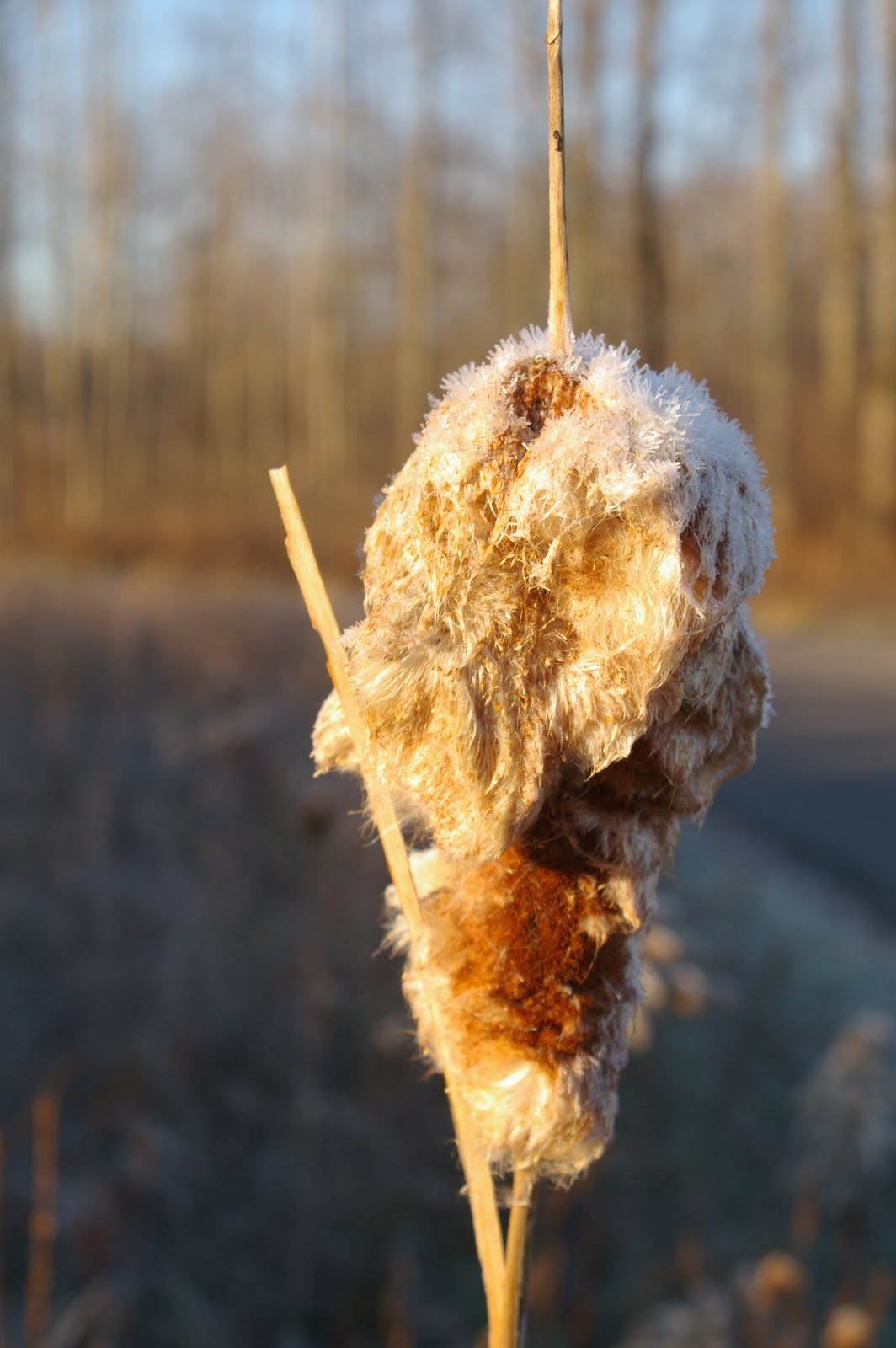
Cattail fluff topped with ice crystals.

Saturday, November 13, 2010


The sky has been clear for several days, which means the land soaks up the sun’s heat but has no insulating clouds to hold it. The other morning I walked the dogs to the end of the driveway through a landscape under the thrall of frost. The grassy fields beyond our woods were painted bluish-green while dried goldenrods and asters had turned amber. These scenes often make me think of my mom’s heirloom ornaments made of frosted glass.


I took an hour to walk around the pond before work. Some of the smaller pools of water had a fragile top layer of ice, but the mass of the pond keeps the temperature more stable and less susceptible to the whims of the air. A muskrat plopped into the water as I passed by. It paddled out a little ways, making a hasty wake in the calm surface. Farther down the shore it climbed up beside another muskrat, pausing to shake water from its fur. They huddled next to each other, taking turns slicking water-resistant oil through their coat. The pond was cold to my touch and not appealing to this naked primate. It will only steadily lose heat even though the muskrats will need to forage through it all winter.


A robin sat at the top of a tree, feathers puffed out. An alder with leaves still green was graced with ice, but next year’s leaves are snug in their protective buds. The clear sky let the sun penetrate the canopy of branches. Thick vegetation which had retained some warmth in earlier hours now held in the cold air, making shadows of frost. Elsewhere leaves glistened with moisture. Evergreen leaves, such as spruce needles and the leaves of a widespread fern with the prosaic name polypody, control the damage of ice and retain their vibrant green through the melt. Others turn waxy due to ice crystals which had broken through cell walls and then melted away. Everyday it seems more of the grass at the end of our driveway dies.

Friday, November 5, 2010

More fall sights


Witch hazel


Beech leaves which may remain up all winter.


Not all that's green is fading.


Reminder of the summer.

Monday, November 1, 2010

Fall sights

One morning I lingered outside work among flocking birds. Red-winged blackbirds clucked, American robins chuckled, and blue jays voiced their boastful calls of “Jay jay!” All three species are not stereotypical migrants, in that some of the population linger in our area all winter. Most of the blue jays stay. The robins that stay will remain restless as they search for high concentrations of the berries that are their main winter food source.

Berries abound. Nearby trees and invasive shrubs have grown up in old fields. Red honeysuckle berries dot the brushy areas. Taller buckthorns arch over parts of the path, their branches encrusted with black berries. Back home I’ve been noticing maple-leafed viburnum with their black berries and the beaten-down but not yet broken pokeweeds thick with clusters of dark purple fruit.

It’s the time of year I can see that I’ve moved to a different stand in the forest by looking down. At the end of the driveway there are the remains of an old homestead and aspen have grown up in what may have been land cleared by its owner. At the first bend in our driveway, deeply lobed oak leaves replace the rounded aspen leaves, oak being more-shade tolerant, where the forest was once logged but probably not completely cleared.

This past week the leaves have been a study in variation, genetic and microclimatic. All the trees have been performing complicated equations involving day-length, temperature, and water loss and coming up with different results. Some beech trees still resemble striped frozen treats from my childhood – an inner halo of green shades into yellow and an outer layer of orange. Many of the more exposed trees stand bare, especially after this last bout of windy weather. The flush of witch hazel blooms seem showier with this more subdued background.

On a recent sunny day, my mother-in-law’s walls were flush with ladybugs. They have descended on our houses, looking for winter shelter. The pets treat them like little toys, although Ivy has trouble with them because she can’t aim for them and have her nose close enough to sniff them at the same time. Sometimes I wonder if our heated homes, far more numerous and widespread than the longhouses of just a few hundred years ago, provide winter habitat for insects which were previously excluded from our region. Of course many insects already wintered in crevices or underground where the temperature was more moderated.

This is the last we’ll see of some creatures for a few months. Red dragonflies were still patrolling the boardwalks near work last week. There was even a pair joined abdomen to head whose eggs will presumably overwinter. Chipmunks dart about the woods, taunting our dogs with their chirps. It might be nice not to be jerked about when a chipmunk notices me walking Bear and vice versa, but the novelty will wear off long before they rouse from hibernation.

Sunday, October 24, 2010

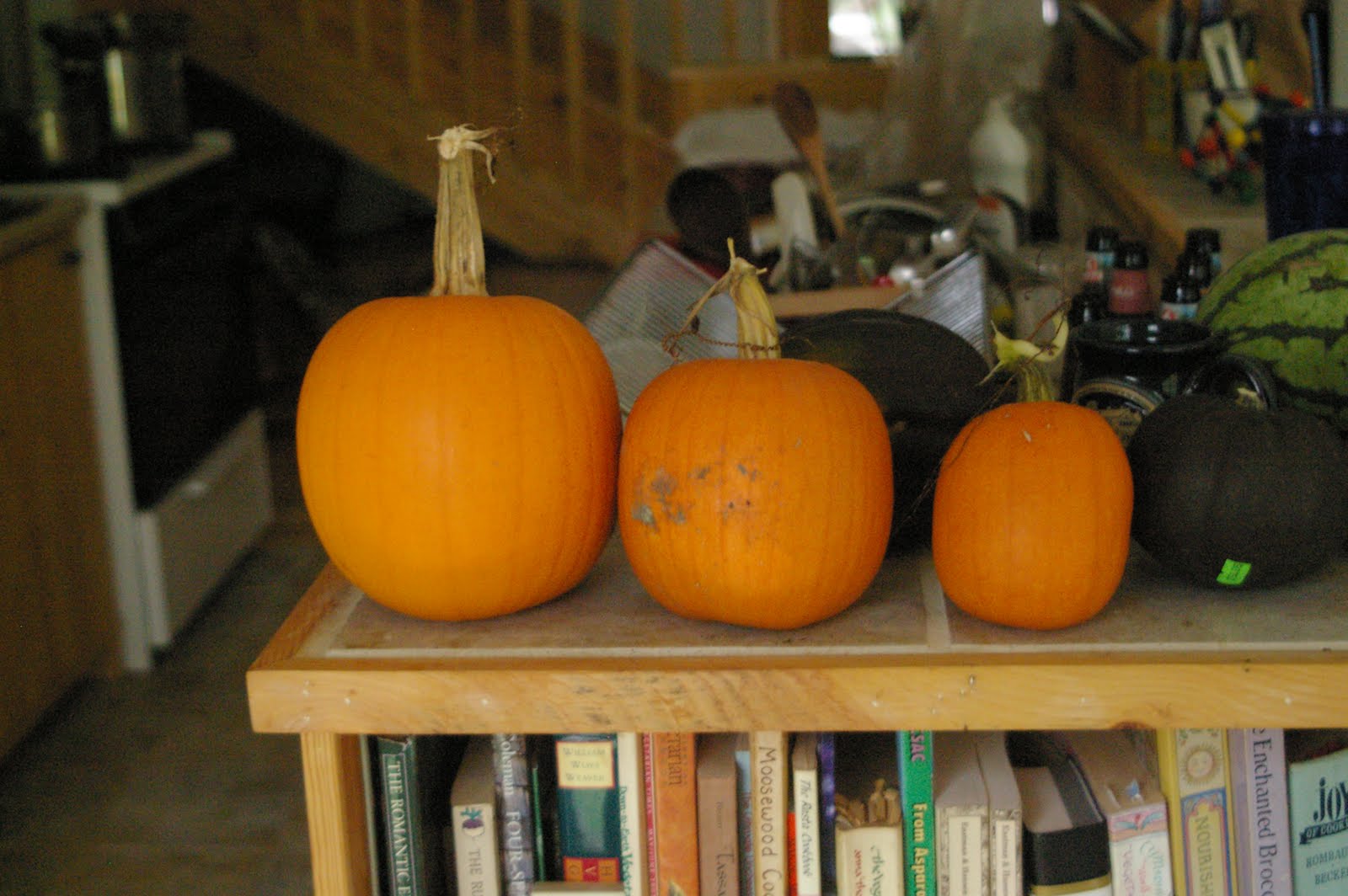
This time of year, I become obsessed with pumpkins. I want to bedeck our house with gourds of all different sizes. Vibrant orange pumpkins are my winter squash of choice, although I know they are surpassed in eating quality by varieties like butternut and buttercup. The outward appearance of many of these sweeter squashes is too pale or merely green, the colors of late or early squash instead of peak.

There’s something satisfying about a hefty squash. It’s like a meaty acorn in a blue jay’s cache which holds out hope and calories against the clouds looming on the horizon, dark and swollen with the first threat of snow. The ephemeral plumpness of wild grapes can’t compare.

Saturday, October 16, 2010

This morning seemed like November. The early light washed out fall’s color scheme so that dramatic clouds overlooked a pale orange landscape. I know that late fall has its own charms, but right now the prospect feels bleak. So here are some pictures in honor of fall’s colors before they’re gone.


Monday, October 11, 2010

I stepped outside yesterday and saw no sign of the forecasted frost in our yard. The dogs and I walked through the debris of fall, like the yellowing leaves and spent goldenrods. A creeping cold infused the calm air, forcing me to keep switching the hand holding the leashes with the hand in my pocket.

Out at the edge of the woods, the scene changed. Dandelion leaves were outlined in white and tufts of grass glittered. A distant lawn seemed dusted by an early snowfall. Lone trees and buildings cast dark, frost-free shadows in the lawns carved out of our forest. Across the fields, a line of sunlight drained down a row of trees as the sun slowly crested a hill, bringing the warmth that would eventually melt the frost away.

Saturday, October 9, 2010

Fall has ushered moisture back into the landscape. Last week I approached the creek bed on our land and heard water happily murmuring to itself. Silt had turned the steady flow grayish-blue, as if the water retained a vague memory of the recent storm’s origin in the Caribbean. Ripples crowned the surface. All the leaves and other organic matter in the bed had led to clumps of foam which emitted trails of bubbles.

My walks take place in a damp world of soggy paths and darkened tree trunks. Often when temperatures fall in the evening and the air loses capacity for holding moisture, a cool mist coalesces among the trees. It pores in wide bands over sections of my ride home. In the morning vast clouds fill the valley with great wisps of mist rising towards the sky.

Saturday, October 2, 2010

Often as I wait for my ride to work I sit on a stone wall beside the edge of a gorge which runs through the town. A box elder leans over the slope, currently thick with bunches of samaras. Another fruit is also present. Grape leaves entwine around the tree’s center and grapes drape in scant bunches.

Nowadays most people consume cultivated grapes like those grown in the surrounding wine country, leaving the smaller wild grapes for wildlife. In this case that might mostly be the gangs of introduced starlings which provide a year-round soundtrack while I wait for my ride. Farther afield plenty of birds and mammals will relish these sweet treats, like a gray catbird I watched picking and choosing among grapes hanging in a tree near my work. Unlike your average human consumer, these wild consumers will then scatter the seeds about with a little fertilizer.

Lately when we go out, we run over the baseball-sized fruit of a black walnut which litters the end of the driveway. The flattened and blackened remains don’t stay on the gravel long, and sometimes we see squirrels carrying them away. If we didn’t have commerce to rely on, the nuts from black walnuts and hickories would be a better target for foraging than greens or fruit. Unlike the sugary grapes, nuts are full of fat and protein and store a lot longer. These traits appeal to the squirrels and jays as well as humans.

Acorns are a traditional food source which is less appealing to modern human foragers. This year we’ve had a large crop. Acorns lie everywhere, alternately brown, tan, burnished red or streaked with different colors. Caps lie askew, empty of their nuts. Some acorns are excavated, leaving shells empty of meat. On a walk I picked up two green acorns with orange rings where the cap had been. I could see the appeal of harvesting large quantities for flour, despite the need for long soakings or boilings to get rid of tannins. They felt waxy and cool in my palm with a satisfying heft that would quickly reward a forager. Although they might already harbor weevil or moth eggs whose occupants would soon hollow out their insides. We most notice vertebrate herbivores, but often arthropods and fungi are more destructive from a plant’s point of view.

Views of our acorn crop:


My mother-in-law often recites “Mighty oaks from little acorns grow.” It’s true that an oak tree grows from something comparatively tiny. If you consider the massive quantities of acorns produced versus the small amount which ever take root, each mighty oak can be seen as the result of a mighty effort.