Sitting by a pond, with the rush of traffic incessant,
red-winged blackbirds buzz and cluck their private worries
into social chatter.
Sun burning alternates with wind
that unsettles the surface of the pond
making eddies of worries that break up the reflection
of peaceful willows caught in a moment
between waking and full summer glory.
I suppose their pause is an illusion
busy factories working inside a still exterior.
Blackbirds posture and call.
Tree swallows dash about in aerial acrobatics.
I want to be more like the willow trees
smooth exterior but deep inner workings
yet I fear I more resemble the water
agitated into a thousand superficial movements.
Monday, April 26, 2010


Saturday, April 17, 2010
Some April flowers

Clumps of tiny violets are scattered in the lawn and leaf litter.

Trilliums opening just in time for a little burst of winter temperatures (and precipitation).
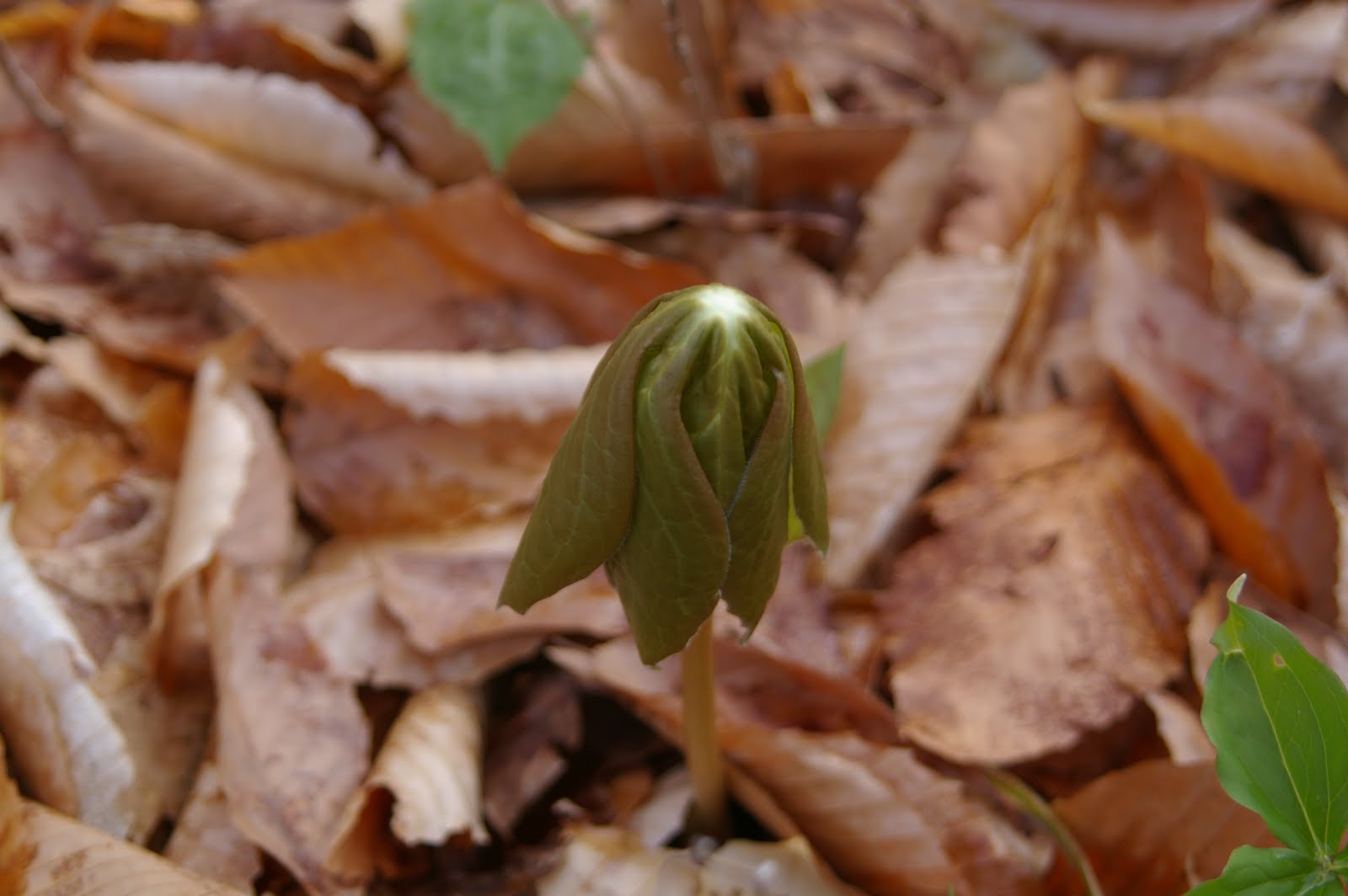
Mayapples unfurl like umbrellas to shade the forest floor.
Sunday, April 11, 2010
Cycles
Shrubs and trees explode in color. Forest flowers open to the unrestrained sun even as leaves emerge from tight buds to eventually shade out the forest floor. Everything is so familiar to me despite the three seasons we’ve been through since then. The script is the same even when the players differ.
That’s true in broad strokes. Late snow cover, early warm days – you can ignore climate change and still the stresses on living things are always at least subtly different this year from last year. Our feelings on the climate are skewed by the present, but trends can involve decades and more. So-called hundred year floods influence real locations of nutrients and plants. Our understanding is limited by the time frames individuals operate on, and since we may not experience rare events multiple times in our lifetime (or our working adult life) we’re often surprised by happenings that are frequent on a geologic time scale.
Crucial events often happen quickly, rarely, and in random places. Predation is like that. So many adaptations are meant to avoid predation, yet actually observing one animal killing another can take a lot of work and luck. Especially with larger carnivores which need to eat less often than a phoebe catching bugs out of the air. The only evidence left may be tufts of bloody fur, clumps of plucked feathers, or unpalatable dragonfly wings as delicate as gossamer.
The world around us is shaped by unseen events and the long-term action of natural laws. History echoes in DNA, dramas played out over eons. Species dance together, for example flowers and their pollinators. Sometimes both groups mutually benefit from their interactions and sometimes one group tries to gain unfair advantages. Other dances are purely antagonistic, like when plants develop defenses to ward off herbivores. Even here competition can become cooperation, as when the toxin caffeine causes humans to spread coffee plants across the tropics.
The history explaining why a community lives in a specific area is also grand compilation of individual stories. Skunk cabbage seeds are swept along by streams, aspen seeds on the wind. Shakespeare enthusiasts import European starlings which now flourish in our fields and cities. Ants carry trillium seeds along through the forest. The world around us has always been in flux, just sometimes in more extreme ways than others.
That’s true in broad strokes. Late snow cover, early warm days – you can ignore climate change and still the stresses on living things are always at least subtly different this year from last year. Our feelings on the climate are skewed by the present, but trends can involve decades and more. So-called hundred year floods influence real locations of nutrients and plants. Our understanding is limited by the time frames individuals operate on, and since we may not experience rare events multiple times in our lifetime (or our working adult life) we’re often surprised by happenings that are frequent on a geologic time scale.
Crucial events often happen quickly, rarely, and in random places. Predation is like that. So many adaptations are meant to avoid predation, yet actually observing one animal killing another can take a lot of work and luck. Especially with larger carnivores which need to eat less often than a phoebe catching bugs out of the air. The only evidence left may be tufts of bloody fur, clumps of plucked feathers, or unpalatable dragonfly wings as delicate as gossamer.
The world around us is shaped by unseen events and the long-term action of natural laws. History echoes in DNA, dramas played out over eons. Species dance together, for example flowers and their pollinators. Sometimes both groups mutually benefit from their interactions and sometimes one group tries to gain unfair advantages. Other dances are purely antagonistic, like when plants develop defenses to ward off herbivores. Even here competition can become cooperation, as when the toxin caffeine causes humans to spread coffee plants across the tropics.
The history explaining why a community lives in a specific area is also grand compilation of individual stories. Skunk cabbage seeds are swept along by streams, aspen seeds on the wind. Shakespeare enthusiasts import European starlings which now flourish in our fields and cities. Ants carry trillium seeds along through the forest. The world around us has always been in flux, just sometimes in more extreme ways than others.
Saturday, April 3, 2010
Watching
Spring wildflowers in the forest hide in plain sight. I only recently started to notice the pale hepaticas among the ubiquitous mud and leaf litter. Fortunately the bumblebee that whizzed by me this morning is not working with the same color spectrum that we see. Insects are the desired audience for these flowers, but the single trout-lily leaves popping up everywhere have no need to attract attention. They leave that drama to their older or just healthier compatriots.
The pleasure of spring flowers strewn like tiny gems across the landscape is worth a closer look, but birds make it easier to watch them this time of year. Males of different songbird (not a technical term) species are walking that fine line between advertising their presence and avoiding predators. Many dress in eye-catching plumage, or at least spiff up their non-breeding plumage so that, for example, male robins sport a darker head and breast. There are always variations – eastern phoebes are little gray and off-white birds that don’t even bother differentiating the plumage of males and females. However they make up for it with their insistent singing of their own name: “Feebee!” This is another way songbirds draw our eyes, by singing species-specific songs from relatively conspicuous perches. I say relative because finding a flycatcher that is about the size of a cell phone in a mess of branches or bramble is not always an easy task.
We’re not the intended audience here either, and sometimes we can be ignored when too males are locked in showy combat. Recently I was able to walk close to two red-winged blackbirds that were going at each other with noisy wing beats. They tumbled about some cattails then spilled out onto the foot path where they irritated a robin so much that he joined in the fight and chased them off.
Most of this is drama, not violence. Individuals bluff and test each other to determine who has control of what resources. Eventually both the singing and the fighting will calm down as neighbors settle in and mostly ignore each other. Until then, there’s plenty for us to observe. Most of our warblers haven’t even arrived yet – not to mention all the trout lilies, trilliums, mayapples, and other flowers I’m looking forward to seeing soon.
The pleasure of spring flowers strewn like tiny gems across the landscape is worth a closer look, but birds make it easier to watch them this time of year. Males of different songbird (not a technical term) species are walking that fine line between advertising their presence and avoiding predators. Many dress in eye-catching plumage, or at least spiff up their non-breeding plumage so that, for example, male robins sport a darker head and breast. There are always variations – eastern phoebes are little gray and off-white birds that don’t even bother differentiating the plumage of males and females. However they make up for it with their insistent singing of their own name: “Feebee!” This is another way songbirds draw our eyes, by singing species-specific songs from relatively conspicuous perches. I say relative because finding a flycatcher that is about the size of a cell phone in a mess of branches or bramble is not always an easy task.
We’re not the intended audience here either, and sometimes we can be ignored when too males are locked in showy combat. Recently I was able to walk close to two red-winged blackbirds that were going at each other with noisy wing beats. They tumbled about some cattails then spilled out onto the foot path where they irritated a robin so much that he joined in the fight and chased them off.
Most of this is drama, not violence. Individuals bluff and test each other to determine who has control of what resources. Eventually both the singing and the fighting will calm down as neighbors settle in and mostly ignore each other. Until then, there’s plenty for us to observe. Most of our warblers haven’t even arrived yet – not to mention all the trout lilies, trilliums, mayapples, and other flowers I’m looking forward to seeing soon.
Saturday, March 20, 2010
Happy Spring
It’s the vernal equinox today. Day-length is changing more rapidly now than it will for another half of a year. Everything else seems to be changing quickly as well. Snow has been banished from most surfaces, leaving a flattened landscape littered with the debris of winter. Chattering flocks of red-winged blackbirds descended on the wetlands at work. Their “kon-ka-reeee” joins with the songs of cardinals, robins, song sparrows, and others as they try to carve out a territory nice enough to entice one or more females to settle down within their sphere of influence.
Echoes of the winter remain. The ghostly corpses of tadpoles lie at the bottom of the muddy inlet that feeds the pond at work, reminders of the January thaw and subsequent refreeze. We haven’t all made it this far, but those of us that have are energized by the increasing amounts of sun and warmth. Chipmunks traded their hypothermic torpor for manic runs through the leaf litter, on the lookout for mating opportunities. Moths slip into the house at night and mourning cloaks, a butterfly species, rise from the driveway when we pass.
For those of us in the northern hemisphere who divide our year into quarters, the vernal equinox is the official start of spring. But every creature is using different criteria to try and perform their life functions at the optimal time. Red maple flowers emerging from their buds, but the more precious leaves will stay tightly bound until the threat of an early spring snow is over. Organisms cannot safely start some processes on the basis of warmth alone. Thus many species have internal calendars just as they have internal clocks. Our absent song birds must leave their wintering grounds early enough to arrive, set up shop, breed, brood, and hatch their offspring in time to raise those hungry mouths on the abundant insects that are coming.
Non-humans don’t know the calendar date, but it seems to me they “know” the time of year in a more full-bodied way than we do. We have relatively weak seasonal responses. Our energy lifts, but we don’t enlarge our reproductive organs like many birds. The mild-mannered robins that flocked all winter have grown testy. They sing long, warbling songs as they perch bold and red in bare branches. The songs are announcement and challenge, and it’s not uncommon to see males going at each other with fluttering wings. They’re trying to establish their territory before the females show up. There’s plenty more changes on the way.
Echoes of the winter remain. The ghostly corpses of tadpoles lie at the bottom of the muddy inlet that feeds the pond at work, reminders of the January thaw and subsequent refreeze. We haven’t all made it this far, but those of us that have are energized by the increasing amounts of sun and warmth. Chipmunks traded their hypothermic torpor for manic runs through the leaf litter, on the lookout for mating opportunities. Moths slip into the house at night and mourning cloaks, a butterfly species, rise from the driveway when we pass.
For those of us in the northern hemisphere who divide our year into quarters, the vernal equinox is the official start of spring. But every creature is using different criteria to try and perform their life functions at the optimal time. Red maple flowers emerging from their buds, but the more precious leaves will stay tightly bound until the threat of an early spring snow is over. Organisms cannot safely start some processes on the basis of warmth alone. Thus many species have internal calendars just as they have internal clocks. Our absent song birds must leave their wintering grounds early enough to arrive, set up shop, breed, brood, and hatch their offspring in time to raise those hungry mouths on the abundant insects that are coming.
Non-humans don’t know the calendar date, but it seems to me they “know” the time of year in a more full-bodied way than we do. We have relatively weak seasonal responses. Our energy lifts, but we don’t enlarge our reproductive organs like many birds. The mild-mannered robins that flocked all winter have grown testy. They sing long, warbling songs as they perch bold and red in bare branches. The songs are announcement and challenge, and it’s not uncommon to see males going at each other with fluttering wings. They’re trying to establish their territory before the females show up. There’s plenty more changes on the way.
Wednesday, March 10, 2010
There are cracks in the icy armor of winter. I've seen them plunge deep into a frozen pond, or expose the gray asphalt of a parking lot. The higher landscapes are still snowbound. In the valley, Gorgeous City lies exposed, its remaining snow confined to piles along edges. Ornamental flowers break through to raise pert little buds to the sky. Rainclouds lurk on the horizon, but for now birds clatter and sing among the barren branches.
Sunday, March 7, 2010
Early morning glistens with ice, but as the day progresses the snow cover sags under the warming sun. It’s maple season, the time of year that sap rises up the maple trees and people are busy tapping into the sweet bounty.
We allowed a neighbor to tap our trees the first year we lived on the land. I regretted it when as he drove around during the mud season in an ATV, compacting the soil. Fortunately this was in a part of the forest with few spring wildflowers. Still, there are plenty of maples in this region which grew up in the open, in old pastures or as borders, while our maple trees have had to compete for resources and therefore are less productive.
Those of us that have the luxury of not living hand-to-mouth have the opportunity to cultivate relationships with the nonhuman world not based on economics. I want to be able to appreciate the forest for its own sake, not for what it provides people. So while I put a lot of energy into gardening on previously cultivated land, it’s hard for me to justify wild harvest. The natural world is under siege from all sides. I don’t want to be a force of destruction in the place I love so much, or to take more than I give back. Since that first year, the maples in our forest have kept their sugars to make leaves, flowers, and samaras, feeding fungi, insects, birds and rodents.
We allowed a neighbor to tap our trees the first year we lived on the land. I regretted it when as he drove around during the mud season in an ATV, compacting the soil. Fortunately this was in a part of the forest with few spring wildflowers. Still, there are plenty of maples in this region which grew up in the open, in old pastures or as borders, while our maple trees have had to compete for resources and therefore are less productive.
Those of us that have the luxury of not living hand-to-mouth have the opportunity to cultivate relationships with the nonhuman world not based on economics. I want to be able to appreciate the forest for its own sake, not for what it provides people. So while I put a lot of energy into gardening on previously cultivated land, it’s hard for me to justify wild harvest. The natural world is under siege from all sides. I don’t want to be a force of destruction in the place I love so much, or to take more than I give back. Since that first year, the maples in our forest have kept their sugars to make leaves, flowers, and samaras, feeding fungi, insects, birds and rodents.
Saturday, February 27, 2010
Snow travel
I was wearing muck boots instead of snowshoes when I took Bear for a walk today, so when we detoured into the woods I sank in with every step. The dogs leapt joyously about like little springboks, but then woodland travels are recreation to them instead of occupation. A wide path behind our house was dotted with the deep imprints of resting deer and laced with their tracks. With no food bowls, these deer probably didn’t appreciate a deep cover of late winter snow. I often find deer beds in the spruce stand, where the ground cover is thinner because the evergreen branches intercept a good amount of snow. Worse for small animals who use the snow for shelter and cover, but better for those of us too big to tunnel.
Deer and most animals find paths of least resistance, and even the dogs readily follow an existing trail in the snow. Deer tracks often follow the driveway, or the trails at work. One aspect of roadways that make them so deadly to our fellow creatures is that they are inviting for travel, although frequent vehicle traffic may make them less so. A common combination of mowed areas and sheltering tree lines makes them attractive as hunting grounds for certain raptors. Hence the ease of seeing red-tails on the highway up to Snowstorm City, but there are less pleasant consequences as well. One study found many dead rough-legged hawks near roads, some of which had been shot by humans who also prefer easy paths.
Late winter is a dangerous time for herbivores because food supplies have been heavily exploited but the cold and often the conditions still require extra energy. Females have the additional burden of carrying one (or more) fetus which will be born in late spring. Deep snows would make stressed deer vulnerable to predation. Winter die-off, while very unfortunate for the individual, can function to decrease competition for scarce resources in the remaining population and results in healthier herds.
At one point, human hunters almost eradicated white-tailed deer in the northeast, but nowadays we’re busy encouraging them to overpopulate. When not feeding them directly, we provide more food to get them through the winter by managing for young forests, which have tasty young trees and sprouts, and planting edible (to deer) landscaping. We’ve decimated or extirpated predator populations. Human predation on deer for sport is less than optimal as long-term population control because humans like to target big, healthy males, whose genes would benefit the population, and are reluctant to kill females who are the real reproductive powerhouses. Ten does can have as many fawns with one buck as with ten. Killing fawns also reduces the reproductive future of the population, but while fawns are the easiest prey for non-human predators, laws and mores prohibit human hunters from taking them.
Although white-tailed deer are native species, their ascendance negatively affects many of our native plants. Their browsing on young trees can inhibit forest regrowth and provide for the increase of less palatable exotic species. Fortunately this edge species spends less time in our forest as the warm seasons begin, because they particularly like to dine on my favorite spring flowers.
Deer and most animals find paths of least resistance, and even the dogs readily follow an existing trail in the snow. Deer tracks often follow the driveway, or the trails at work. One aspect of roadways that make them so deadly to our fellow creatures is that they are inviting for travel, although frequent vehicle traffic may make them less so. A common combination of mowed areas and sheltering tree lines makes them attractive as hunting grounds for certain raptors. Hence the ease of seeing red-tails on the highway up to Snowstorm City, but there are less pleasant consequences as well. One study found many dead rough-legged hawks near roads, some of which had been shot by humans who also prefer easy paths.
Late winter is a dangerous time for herbivores because food supplies have been heavily exploited but the cold and often the conditions still require extra energy. Females have the additional burden of carrying one (or more) fetus which will be born in late spring. Deep snows would make stressed deer vulnerable to predation. Winter die-off, while very unfortunate for the individual, can function to decrease competition for scarce resources in the remaining population and results in healthier herds.
At one point, human hunters almost eradicated white-tailed deer in the northeast, but nowadays we’re busy encouraging them to overpopulate. When not feeding them directly, we provide more food to get them through the winter by managing for young forests, which have tasty young trees and sprouts, and planting edible (to deer) landscaping. We’ve decimated or extirpated predator populations. Human predation on deer for sport is less than optimal as long-term population control because humans like to target big, healthy males, whose genes would benefit the population, and are reluctant to kill females who are the real reproductive powerhouses. Ten does can have as many fawns with one buck as with ten. Killing fawns also reduces the reproductive future of the population, but while fawns are the easiest prey for non-human predators, laws and mores prohibit human hunters from taking them.
Although white-tailed deer are native species, their ascendance negatively affects many of our native plants. Their browsing on young trees can inhibit forest regrowth and provide for the increase of less palatable exotic species. Fortunately this edge species spends less time in our forest as the warm seasons begin, because they particularly like to dine on my favorite spring flowers.
Saturday, February 20, 2010
Winter sights
I’m not a huge fan of birding by car –over two summers I spent months driving to find birds in a land of bad radio. I do like to keep a look out when I’m in a car anyway. I notice a lot of raptors; mostly red-tails perched in trees near the road but sometimes a smaller hawk or even a northern harrier floating over rolling hills. In a couple of months kestrels will be impersonating mourning doves on telephone wires, or hovering high above some unlucky meadow vole (or grasshopper).
Kestrels are still here, although in reduced numbers. Our winter bird population is poor in species because the ones we keep are outnumbered by those we lose to milder climes. Some of these areas might dispute that description this year with all the snowstorms, but chance weather events are a danger which birds cannot completely avoid. Migrating can make the long-term chance of catastrophic weather events much less. Fortunately for those of us feeling the February blues, migration gives us a few surprises from the depths of the arctic that don’t involve ice and snow.
Snow buntings littered the edge of the field as I drove down our road last week. Come spring, these creamy white and brown birds will trade our forest-edged fields and beaches for the tree-less tundra of the high arctic. Males will wear down the tips of their feathers to expose pretty black and white birds beneath the bland façade we see. No need to be striking (and more exposed to predators) when they’re not interested in carving out territories on our lands.
Predators can better afford to be striking year-round. On a recent drive up to Snowstorm City, a hawk soaring just above the highway struck me as more patterned than the red-tail I was expecting. She alighted onto a nearby tree and her dark patches revealed that she was a rough-legged hawk, another arctic visitor. Both of these species have benefited from the increase in open land created in this area through European settlement, but the mammal-eating rough-legged hawk has been hurt more by the conversion of grassland to cropland. Maybe she’s feeling her own version of the February blues. Maybe it will be a relief to get away from the land of snow and ice to what she experiences as a land of grass, flowers and skittering mammals. Just as it will be a relief to me to go back to birding on foot.
Kestrels are still here, although in reduced numbers. Our winter bird population is poor in species because the ones we keep are outnumbered by those we lose to milder climes. Some of these areas might dispute that description this year with all the snowstorms, but chance weather events are a danger which birds cannot completely avoid. Migrating can make the long-term chance of catastrophic weather events much less. Fortunately for those of us feeling the February blues, migration gives us a few surprises from the depths of the arctic that don’t involve ice and snow.
Snow buntings littered the edge of the field as I drove down our road last week. Come spring, these creamy white and brown birds will trade our forest-edged fields and beaches for the tree-less tundra of the high arctic. Males will wear down the tips of their feathers to expose pretty black and white birds beneath the bland façade we see. No need to be striking (and more exposed to predators) when they’re not interested in carving out territories on our lands.
Predators can better afford to be striking year-round. On a recent drive up to Snowstorm City, a hawk soaring just above the highway struck me as more patterned than the red-tail I was expecting. She alighted onto a nearby tree and her dark patches revealed that she was a rough-legged hawk, another arctic visitor. Both of these species have benefited from the increase in open land created in this area through European settlement, but the mammal-eating rough-legged hawk has been hurt more by the conversion of grassland to cropland. Maybe she’s feeling her own version of the February blues. Maybe it will be a relief to get away from the land of snow and ice to what she experiences as a land of grass, flowers and skittering mammals. Just as it will be a relief to me to go back to birding on foot.
Saturday, February 13, 2010
Lilliputian neighbors

Protected mouse runway.

Evidence of a rodent taking advantage of birdseed on the porch.

Interface between the worlds above and below the snow.
Saturday, February 6, 2010
Mice
A week ago I went to pick up the coffee mug I’d left in our car when I noticed mouse sprinkles on top. It’s bad enough that mice are hanging out in our car, but I’d rather they didn’t use my coffee mug as a perch.
My glimpses of live mice tend to be as they dash across a trail or down a hole. Occasionally I encounter stunned juveniles that the cats have been batting around the house. Deer mice and white-footed mice are common and populous throughout North America. I can accept that my cats kill mice in the house since that’s the human-cat contract that underlies the whole domestication of cats. However, outside I feel the predators that don’t have their lives catered to don’t need extra competition.
Mice must hide from aerial predators – hawks and owls, as well as mammals as small as the short-eared shrew and as large as foxes, or even coyotes. Mice move under cover of snow and night. In the morning tracks appear on the snow surface, moving from woody cover to woody cover. Snow melt exposes their long tunnels, still roofed or collapsed into trenches. While some larger-bodied rodents such as chipmunks lie in torpor underground next to their personal food stash, mice are out searching for edibles to stoke their internal fire.
Smells don’t travel as well in the cold, yet our woodland mice sniff out seeds, insects, and sometimes small dead bodies for sustenance. They found the bag of grass seed carelessly left in the shed and left a mess of husks and mouse sprinkles. We should have known better, but then we stuff our lives full of tasks while mice have the long winter night to focus on a few essentials.
My glimpses of live mice tend to be as they dash across a trail or down a hole. Occasionally I encounter stunned juveniles that the cats have been batting around the house. Deer mice and white-footed mice are common and populous throughout North America. I can accept that my cats kill mice in the house since that’s the human-cat contract that underlies the whole domestication of cats. However, outside I feel the predators that don’t have their lives catered to don’t need extra competition.
Mice must hide from aerial predators – hawks and owls, as well as mammals as small as the short-eared shrew and as large as foxes, or even coyotes. Mice move under cover of snow and night. In the morning tracks appear on the snow surface, moving from woody cover to woody cover. Snow melt exposes their long tunnels, still roofed or collapsed into trenches. While some larger-bodied rodents such as chipmunks lie in torpor underground next to their personal food stash, mice are out searching for edibles to stoke their internal fire.
Smells don’t travel as well in the cold, yet our woodland mice sniff out seeds, insects, and sometimes small dead bodies for sustenance. They found the bag of grass seed carelessly left in the shed and left a mess of husks and mouse sprinkles. We should have known better, but then we stuff our lives full of tasks while mice have the long winter night to focus on a few essentials.
Saturday, January 30, 2010
Potentials

Minds tend to extrapolate the present into the future. It’s hard to remember the forest clothed in summer, and easy to imagine winter will stretch on like the snow cover stretches into the forest as far as the eyes can see. It laps up against tree trunks and rolls over fallen branches. The surface of snow unites the forest with the pond, making the world seem like one big shallow sea.
Why shouldn’t it, since snow is water in another guise? Yet the difference between liquid and solid water is not merely academic, and oxygen-breathing mice can build tunnel systems in the crystalline structure of snow that shelters them from both the freezing air and predatory eyes. This is a feat they can’t replicate in liquid water or ice. But the solid state is impermanent.
As if to prove the world is never as it seems, this week a storm system brought heavy rains down on the snow that had survived a recent warm snap. The rain swept the land clean of snow so that what had been a virtual sea idly covering the land became active water with places to go. Rivers swelled. Water roared down gorges and flew into the air as great veils of mist.

In the forests and bogs by my job, low areas teemed with muddy water. Creamy sheets of ice lay at or below the surface. The snow melt exposed green moss and rusty dried ferns. The world was saturated by rain and saturated in rich colors. Over it all hung the salty exhalations of decay from disturbed wetland soils.
Just as the snow had the dormant potential to be liquid, undeveloped land can have the potential to hold lots of water. Water can move pretty easily on roads and flat lawns, but bogs have depressions to fill and vegetation, both alive and deceased, to get in the way. It’s hard for the mind to see flooding that’s not happening. Unlike the bloom of summer, the water retention potential of natural areas is best noticed when it’s already gone.

Saturday, January 23, 2010
The winter forest can seem very empty compared to its spring and summer counterparts. I have to look harder to appreciate it. The forest does not ring with song, but find a winter flock and the trees seem full of chirping and foraging chickadees. Male goldfinches have donned duller plumages, but cardinals are paint drops scattered in the snowy landscape.
In the relative quiet, it’s not unusual to hear the tapping of a foraging woodpecker or the repeated kuk of a pileated woodpecker which, thanks to creative use of the sound in jungle movies, puts one in mind of a much more steamy setting rather than a forest of naked trees under-layered by snow softening in a winter sun. I’ve been seeing these birds around lately. I often think that a blue jay is crossing the pond at work, then notice that the black and white wing pattern is more striking and the head is bright red. My favorite encounters are out in the woods when in a rush of wings, a bird which is roughly the length from my elbow to my fingertips folds up against a large tree trunk nearby.
Sometimes what appears to be a mated pair will land on trees near each other, two stately birds whose only difference is the male has a red mustache. Pairs seem to keep to the same territory year-round, defending it more rigorously during the breeding season. Young birds may disperse during migration, such as the two female hatch-year birds which the banders I know caught last year. Both people came away bloody.
Like all flying birds (as opposed to flightless birds), pileateds weigh much less than they “should” based on mammal standards but are very strong in the ways they need to be. The big chunks of forest at work and at our house provide good habitat for pileateds, which through their excavating work provide services for other forest dwellers. Old nest holes are a good resource for smaller cavity nesting birds from wrens to chickadees. Many non-birds also take shelter or residence in these holes. The rectangular cavities pileateds excavate to get to beetles and ants can provide food for other insect-eaters.
There are plenty of other woodpeckers around these two pieces of forest, but the pileated is the largest and most sensitive to forest maturity. Trees in this area have gained a huge amount of ground since the early years of European clear cutting, and pileated woodpeckers have rebounded from widespread hunting and habitat loss. But not all wooded areas are equal. Density of pileateds appears to decrease with forest fragmentation. That is, the more forests are broken up by other habitat like fields, farms or lawns, the fewer pileateds can live there. Several other species have decreased numbers in the fragmented habitat we create everywhere, although some wildlife species prefer this kind of habitat. These are the ones you see everywhere, like deer and robins.
Not just any forest will do, though. Pileateds need big trees to nest and roost in, and they need trees full of tasty insects. There’s a saying that a healthy forest is full of disease, and that’s certainly true from a woodpecker’s point of view. Age of the forest is less important as long as there are some old dead trees still standing. Snags, as standing dead trees are known in forestry, are certainly not lacking in our forest. Some trunks shed clumps of bark but others are identical to the living trees surrounding them until I look up to where they break off suddenly. Often then I’ll notice many holes from insects benefiting from the death, and sometimes holes made by their pursuers. These signs of life ring out, even in the silence.
In the relative quiet, it’s not unusual to hear the tapping of a foraging woodpecker or the repeated kuk of a pileated woodpecker which, thanks to creative use of the sound in jungle movies, puts one in mind of a much more steamy setting rather than a forest of naked trees under-layered by snow softening in a winter sun. I’ve been seeing these birds around lately. I often think that a blue jay is crossing the pond at work, then notice that the black and white wing pattern is more striking and the head is bright red. My favorite encounters are out in the woods when in a rush of wings, a bird which is roughly the length from my elbow to my fingertips folds up against a large tree trunk nearby.
Sometimes what appears to be a mated pair will land on trees near each other, two stately birds whose only difference is the male has a red mustache. Pairs seem to keep to the same territory year-round, defending it more rigorously during the breeding season. Young birds may disperse during migration, such as the two female hatch-year birds which the banders I know caught last year. Both people came away bloody.
Like all flying birds (as opposed to flightless birds), pileateds weigh much less than they “should” based on mammal standards but are very strong in the ways they need to be. The big chunks of forest at work and at our house provide good habitat for pileateds, which through their excavating work provide services for other forest dwellers. Old nest holes are a good resource for smaller cavity nesting birds from wrens to chickadees. Many non-birds also take shelter or residence in these holes. The rectangular cavities pileateds excavate to get to beetles and ants can provide food for other insect-eaters.
There are plenty of other woodpeckers around these two pieces of forest, but the pileated is the largest and most sensitive to forest maturity. Trees in this area have gained a huge amount of ground since the early years of European clear cutting, and pileated woodpeckers have rebounded from widespread hunting and habitat loss. But not all wooded areas are equal. Density of pileateds appears to decrease with forest fragmentation. That is, the more forests are broken up by other habitat like fields, farms or lawns, the fewer pileateds can live there. Several other species have decreased numbers in the fragmented habitat we create everywhere, although some wildlife species prefer this kind of habitat. These are the ones you see everywhere, like deer and robins.
Not just any forest will do, though. Pileateds need big trees to nest and roost in, and they need trees full of tasty insects. There’s a saying that a healthy forest is full of disease, and that’s certainly true from a woodpecker’s point of view. Age of the forest is less important as long as there are some old dead trees still standing. Snags, as standing dead trees are known in forestry, are certainly not lacking in our forest. Some trunks shed clumps of bark but others are identical to the living trees surrounding them until I look up to where they break off suddenly. Often then I’ll notice many holes from insects benefiting from the death, and sometimes holes made by their pursuers. These signs of life ring out, even in the silence.
Friday, January 22, 2010
Signs of life

Gray squirrel in a moment of indecision.

Evidence of insects and a foraging woodpecker.

A snag (standing dead tree) much loved by woodpeckers.

Life from death.
Friday, January 1, 2010
The winter world is introspective. All around us beings slumber, and our energies move inside after three long seasons of gardening. The last couple spinach crops are frozen under a layer of snow. Fortunately there's a lot to do as we move back into our radically remodeled house.
I take breaks to walk outside, where everything was so still yesterday. Snow rested along top of motionless branches. Muffled sounds came from distant beings doing distant things. Geese honked as they made their evening movements, traffic rushed along, and two pops of gunshot rang out. This is the country, after all.
My footsteps exposed green ferns through the snow. Like my spinach (still edible as of a few days ago), life bides its time in the cold. I wondered if enough light bled for the spruce and pine needles up above to photosynthesize, or if they idled on stored energy like our solar-panel driven electric system under the solid gray sky.
The winter flocks were elsewhere, and not even a chickadee called in the silence. Squirrels and rabbits were present in signs, tracks crossing my path on unknown errands and their lingering scents which my nose is unable read. If the absent birds left scent trails I had no way to know, my weak nose sniffling in the cold, sterile air. No matter how many winters I go through, I always seem unaccustomed to it when it comes back around.
I take breaks to walk outside, where everything was so still yesterday. Snow rested along top of motionless branches. Muffled sounds came from distant beings doing distant things. Geese honked as they made their evening movements, traffic rushed along, and two pops of gunshot rang out. This is the country, after all.
My footsteps exposed green ferns through the snow. Like my spinach (still edible as of a few days ago), life bides its time in the cold. I wondered if enough light bled for the spruce and pine needles up above to photosynthesize, or if they idled on stored energy like our solar-panel driven electric system under the solid gray sky.
The winter flocks were elsewhere, and not even a chickadee called in the silence. Squirrels and rabbits were present in signs, tracks crossing my path on unknown errands and their lingering scents which my nose is unable read. If the absent birds left scent trails I had no way to know, my weak nose sniffling in the cold, sterile air. No matter how many winters I go through, I always seem unaccustomed to it when it comes back around.
Thursday, May 28, 2009
The first thing to note about our forest is age. Not the centuries of the pacific northwest, granted, but our large trees tend to maple, ash and hickory, not fast-growing aspen and willow. I once encountered a large maple that had fallen long ago and played nursery log to several other maples, now grown just as big. Age is spoken by the lush undergrowth of native and knee-high skunk cabbage flourishing in the shade.
The second thing to note about the forest is that you are not entirely welcome guest. This is suggested by the delicate succulent stems popping up everywhere you want to step, and underscored by the scattered poison ivy that occasionally reaches up on vines toward you. I’ve read some things suggesting that even the native Americans who had lived in this area were not entirely comfortable in the deep forest.
The theme of this season is busyness, seen in the proliferation of green solar panels making sugars from sunlight. Every individual is a selfish, separate world, yet interconnected. Even the birds going about their business are more native than you though they may spend most of the year somewhere else. They’re following their own agendas. Phoebes are busy feeding young. Later-arriving eastern wood pewees are still plighting their troth, singing away even late morning when the phoebes are mostly silent. Then there are the migrators that find temporary solace here, like the blackpoll warbler which still has to travel north to the boreal forest before he can start breeding.
In the green world of the forest, I find solace from my own busyness.
The second thing to note about the forest is that you are not entirely welcome guest. This is suggested by the delicate succulent stems popping up everywhere you want to step, and underscored by the scattered poison ivy that occasionally reaches up on vines toward you. I’ve read some things suggesting that even the native Americans who had lived in this area were not entirely comfortable in the deep forest.
The theme of this season is busyness, seen in the proliferation of green solar panels making sugars from sunlight. Every individual is a selfish, separate world, yet interconnected. Even the birds going about their business are more native than you though they may spend most of the year somewhere else. They’re following their own agendas. Phoebes are busy feeding young. Later-arriving eastern wood pewees are still plighting their troth, singing away even late morning when the phoebes are mostly silent. Then there are the migrators that find temporary solace here, like the blackpoll warbler which still has to travel north to the boreal forest before he can start breeding.
In the green world of the forest, I find solace from my own busyness.
Tuesday, May 19, 2009
On flowers
The trilliums have become ragged in the woods around our yard. Flowers are a study in impermanence. We often conflate the flower with the plant, but a flowers is merely a means to an end - sexual reproduction. A flower is a free loader on the leaves, roots and stems that pay their way. Many of our forest flowers don't even bother with the business of sexual reproduction until they've established themselves as a root system. The thick patches of mayapple in our forest are mostly the result of colonization by underground rhizomes - i.e. asexual reproduction. An individual may labor at this honest work for four years or so before entering the sordid world of flowers, pollinators, and seeds.
In the relatively stable environment of the deep forest, there's a good chance that a site which was hospitable last year will be the same this year, whereas seed set and dispersal is more risky. Sexual reproduction is a luxury in the short term. Jack-in-the-pulpit decides how much energy to spend based on its age and condition. Younger or stressed plants make male flowers , while older and more healthy plants can invest in female flowers which will also entail producing costly seeds and berries.
Many flowers are alluring to our eyes with their colors and symmetry, even though we are not the intended audience when it comes to wildflowers. Jack-in-the-pulpits are easy for humans to overlook, but their attraction to insect pollinators come from a mushroom-like odor which fools gnats into entering by mistake. Ultimately a flowering plant has its own agenda, and one can't believe all its pretty promises.
In the relatively stable environment of the deep forest, there's a good chance that a site which was hospitable last year will be the same this year, whereas seed set and dispersal is more risky. Sexual reproduction is a luxury in the short term. Jack-in-the-pulpit decides how much energy to spend based on its age and condition. Younger or stressed plants make male flowers , while older and more healthy plants can invest in female flowers which will also entail producing costly seeds and berries.
Many flowers are alluring to our eyes with their colors and symmetry, even though we are not the intended audience when it comes to wildflowers. Jack-in-the-pulpits are easy for humans to overlook, but their attraction to insect pollinators come from a mushroom-like odor which fools gnats into entering by mistake. Ultimately a flowering plant has its own agenda, and one can't believe all its pretty promises.
Sunday, May 17, 2009
My childhood was spent in suburbia among house sparrows and dandelions. As a result, sometimes native species seem more exotic than the invasives. Scarlet tanagers bring a dash of the tropics to our temperate deciduous forests, although this is appropriate since they spent our winter in South America. Flowering skunk cabbages seem to belong to some alien planet. Later blooms like jack-in-the-pulpit defy a simple flower diagram.

Mayapple is one of my favorite plants to watch. I noticed it last month popping out of the ground leaves and all, like little umbrellas.

They've only just begun blooming, but you have to crouch down to discover the subtle pleasure of their concealed flowers.


Mayapple is one of my favorite plants to watch. I noticed it last month popping out of the ground leaves and all, like little umbrellas.

They've only just begun blooming, but you have to crouch down to discover the subtle pleasure of their concealed flowers.

Spring foliage

This is the first year I've noticed that the colors of emerging leaves evoke the colors of the autumn leaf show. The colors are more pastel, but no less beautiful to me.

Many of the colors have been diluted since these pictures were taken a couple weeks ago. We still see yellows and oranges at the edges of the forest, but the leaves around our house surround us in a curtain of emerald green.
Sunday, May 10, 2009
April flowers - Part 2
May has hit its stride, but I wanted to revisit April before too much time passes. Our Internet connection was glacially slow that month, but out in the forest things were moving at a fast clip. Fortunately my camera was still working well.
Taking certain pictures turned out to be tricky. I've never learned much about photography, so it was only this year that I realized that flower pictures taken during lower light conditions are better than those taken with the sun high in the sky on a cloudless day. However, spring flowers don't open randomly. Many stay closed when the air temperature is too cool for pollinators to be flying around, such as during mornings, evenings, and cloudy days when my camera was all ready to record their beauty. Even when I was out when the flowers where still open but the sunshine had started to fade, blossoms would be drooping instead of all facing in the same direction.
Then there's the short blooming period. This bloodroot flower will pollinate itself if cold weather or other factors inhibit insect pollination so it can move along to seed formation.

The speckled leaves of trout lilies carpet many areas of the forest floor and even the edges of our lawn, but only plants old enough to have two leaves will flower. I watched the buds for days, waiting for them to open, then could only look on as they opened so wide in the blazing spring sunlight that the petals touched in back. The few pictures I did take were nice but not as impressive.

Finally, five days before the end of April, waves of trillium opened. Perhaps because temperatures had warmed, I haven't noticed trilliums to close, making them ideal subjects for me to photograph.

Taking certain pictures turned out to be tricky. I've never learned much about photography, so it was only this year that I realized that flower pictures taken during lower light conditions are better than those taken with the sun high in the sky on a cloudless day. However, spring flowers don't open randomly. Many stay closed when the air temperature is too cool for pollinators to be flying around, such as during mornings, evenings, and cloudy days when my camera was all ready to record their beauty. Even when I was out when the flowers where still open but the sunshine had started to fade, blossoms would be drooping instead of all facing in the same direction.
Then there's the short blooming period. This bloodroot flower will pollinate itself if cold weather or other factors inhibit insect pollination so it can move along to seed formation.

The speckled leaves of trout lilies carpet many areas of the forest floor and even the edges of our lawn, but only plants old enough to have two leaves will flower. I watched the buds for days, waiting for them to open, then could only look on as they opened so wide in the blazing spring sunlight that the petals touched in back. The few pictures I did take were nice but not as impressive.

Finally, five days before the end of April, waves of trillium opened. Perhaps because temperatures had warmed, I haven't noticed trilliums to close, making them ideal subjects for me to photograph.

Thursday, May 7, 2009
Brave new spring
The forest in spring is the forest primordial. Everything seems new and untouched, especially by humans. This morning I set out with my camera into the forest gleaming with the remnants of overnight rain. I stepped gingerly over carpets of single trout lily leaves. Islands of lush blue cohosh and wild leeks rose from the leaf litter, populated with scattered native flowers like trilliums and mayapples.
I had been wandering and snapping random pictures for while when I stumbled across a familiar tall plant with white flowers – garlic mustard, an invasive species we tend to find near the road and along our driveway. Aghast, I spent the next ten minutes or so pulling every plant I could find, both tall and tiny, trying hard to coax all their roots from the wet soil. Finally I set out towards home with a wad of fragrant plant material held tight in one hand.
Except that I wasn’t entirely sure where I was. After casting about for a bit, I ended up having to cross through an unfamiliar stream bed. This area was wreathed in the most brilliant green. Huge skunk cabbage and young jewelweed decorated the hillocks where fern heads were unfurling. Horsetails stuck out of the dark, still water, glistening with rain drops. And there I was, stomping through this prehistoric scene like Godzilla, clutching a whole mess of invasive species which had not managed to reach this oasis on their own.
As far as I know I didn’t drop any, but this incident reminded me that sometimes we are the most immediate danger to these woods. All I can hope is that by managing invasives when we can, we are doing more good than harm.
Monday, May 4, 2009
The change in daylight hours is driven by the orientation of the earth in relation to the sun. The changes in the plant community on the forest floor, while ultimately due to this relationship, are shaped by more local factors. April began with an almost barren canopy except for evergreens. Someone fair-skinned such as myself had no refuge from the sun in the middle of a hot, cloudless day. Today the forest rivals autumn leaf shows for beauty. New growth, especially in the understory, gives the forest a green blush. Yellow and white flowers remain along with more showy flowering trees in peoples' yards. The deep red flowers of red maples have become orange clusters of winged fruit. Willows drape long yellow locks over the pond at work, betraying green roots as the leaves come in.
This is the timeline which spring flowers are constrained by - the return of the summer canopy. They need enough warmth and sun to grow flowers and attract pollinators (although some species have ways around the latter problem). But if they flower too long and the trees cast them into shade, they won't have enough energy to produce fruit. Many spring flowers respond by being ephemeral, which is a poetic way to say short-lived. They grace the forest floor with a burst of beauty before melting away.
This is the timeline which spring flowers are constrained by - the return of the summer canopy. They need enough warmth and sun to grow flowers and attract pollinators (although some species have ways around the latter problem). But if they flower too long and the trees cast them into shade, they won't have enough energy to produce fruit. Many spring flowers respond by being ephemeral, which is a poetic way to say short-lived. They grace the forest floor with a burst of beauty before melting away.
Sunday, May 3, 2009
April flowers - Part 1
The change in daylight hours happens more quickly around the equinoxes. Similarly, change in the forest seems to have moved at a lightning pace since the spring equinox on March 20th. Even early April was a different world. Plants that littered the forest everywhere one looked have been completely altered, yielding the stage to the next eye-catching flower. At first skunk cabbage had the most obvious reproductive structure.

Now these gnome hoods have been replaced by lush leaf spreads.

The first of the more stereotypical flowers were the small white or purple flowers of hepatica I noticed tucked among the leaf litter on April 3.

In mid-April, while hepatica was wide open in a last burst of color before turning to seed pods, the real diversity began to emerge. One native among many was blue cohosh, whose stems rose in stooped forms reminiscent of a Dr. Seuss book.

Blue cohosh has settled in after a couple weeks, retaining just a tint of blue as it mingles with the trilliums and mayapples that dominate the forest floor.

To be continued...

Now these gnome hoods have been replaced by lush leaf spreads.

The first of the more stereotypical flowers were the small white or purple flowers of hepatica I noticed tucked among the leaf litter on April 3.

In mid-April, while hepatica was wide open in a last burst of color before turning to seed pods, the real diversity began to emerge. One native among many was blue cohosh, whose stems rose in stooped forms reminiscent of a Dr. Seuss book.

Blue cohosh has settled in after a couple weeks, retaining just a tint of blue as it mingles with the trilliums and mayapples that dominate the forest floor.

To be continued...
Wednesday, April 1, 2009
In my haste the other day, I forgot to mention another native species with blooms evident in the forest: red maple. The tight red buds clustered at the end of branches have opened into sprays of white stamens or pistils, depending on whether the flower is male or female. It's easy to forget that most of our deciduous trees are technically "flowering plants" because the seeds are more noticeable than the flowers. Maybe this is because the seeds fall to our level, whereas one might not notice flowers high up in branches if they weren't already looking up through binoculars. Primarily wind-pollinated, red maple blooms before the canopy leafs out and impedes air flow, which also makes the event easier to observe. in a complex ecosystem such as the northeastern forest, resources such as light, pollinators and air space have many users. One way many organisms avoid competition is through timing.
Monday, March 30, 2009
Signs of spring
Outside, everyone is singing. Including myself on days when I can't resist bringing the guitar out to play in the warm air under blue skies. A month ago I was stopped in my tracks by a red-winged blackbird belting out "cor-a-lee," but now flocks of noisy blackbirds and grackles seem to be everywhere. An American robin that claimed our yard spends his time whistling from various trees. Eastern bluebirds and meadowlarks serenade the fields when we walk Bear on our free mornings.
Even though birds are on the move and green has broken out on the ground, ice still clings on in the shadows and during colder days. We have crocuses and coltsfoot flowering in our yard, but the only signs of native flowers I've seen in the forest so far are the gnome-like hoods of skunk cabbage popping up in and along our stream. These plants are related to tropical species which use metabolic heat to amplify their smell, often one reminiscent of rotting meat, in order to attract their pollinators, often flies. Operating on the principle that it's easier for the forces of evolution to modify an existing trait for a new task than to mutate an entirely new trait, the heat generated by flowering skunk cabbage melts through ice and snow as well as encouraging pollinators to visit.
Amphibians have also awoken. Spring peepers, like wood frogs, actually hibernate close enough to the air to partially freeze, using glucose as anti-freeze in vital parts of their bodies. The chorus of spring peepers has been hard to miss, although actually seeing the tiny frogs requires effort. They gather around the temporary pools that form on the other side of our property from the stream and the wet land around it. Some warm night soon I hope to head out with a flashlight and search for peepers and other amphibians. The problem is that spring has also meant spring cleaning for us - a massive cleaning out of our house in preparation for a complete rebuild. This also has meant that our internet connection at home has gone from slow to non-existent. I will try to keep writing online through this exciting time of new beginnings, but no promises.
Even though birds are on the move and green has broken out on the ground, ice still clings on in the shadows and during colder days. We have crocuses and coltsfoot flowering in our yard, but the only signs of native flowers I've seen in the forest so far are the gnome-like hoods of skunk cabbage popping up in and along our stream. These plants are related to tropical species which use metabolic heat to amplify their smell, often one reminiscent of rotting meat, in order to attract their pollinators, often flies. Operating on the principle that it's easier for the forces of evolution to modify an existing trait for a new task than to mutate an entirely new trait, the heat generated by flowering skunk cabbage melts through ice and snow as well as encouraging pollinators to visit.
Amphibians have also awoken. Spring peepers, like wood frogs, actually hibernate close enough to the air to partially freeze, using glucose as anti-freeze in vital parts of their bodies. The chorus of spring peepers has been hard to miss, although actually seeing the tiny frogs requires effort. They gather around the temporary pools that form on the other side of our property from the stream and the wet land around it. Some warm night soon I hope to head out with a flashlight and search for peepers and other amphibians. The problem is that spring has also meant spring cleaning for us - a massive cleaning out of our house in preparation for a complete rebuild. This also has meant that our internet connection at home has gone from slow to non-existent. I will try to keep writing online through this exciting time of new beginnings, but no promises.
Subscribe to:
Posts (Atom)
